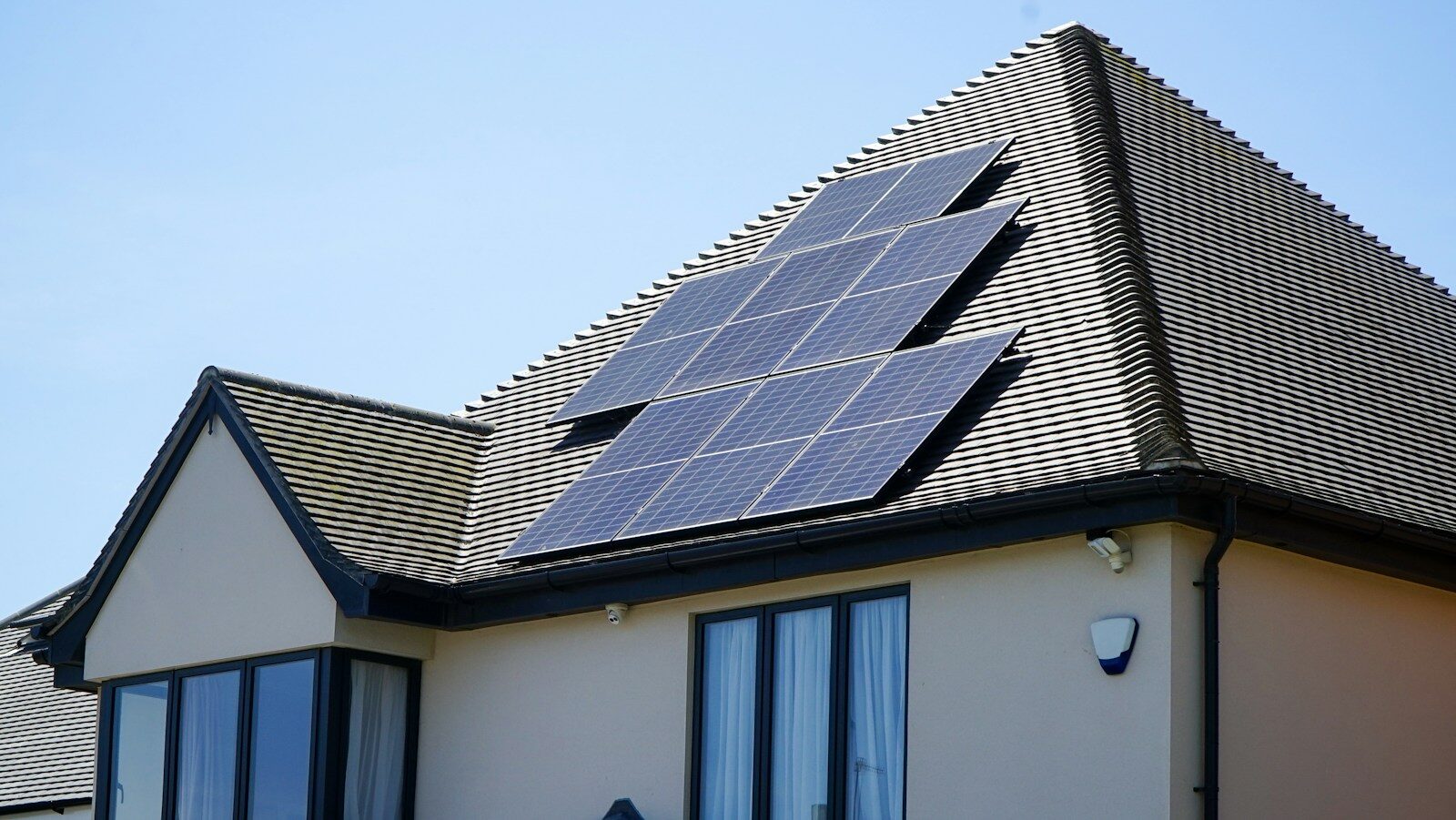
For many UK owner-occupiers with a suitable roof, solar power is worth considering. The financial case is strongest when the roof has little shade, the household expects to stay for long enough to recover the cost, and a useful share of the electricity can be used at home or exported on a good tariff. It becomes weaker with heavy shade, imminent roof repairs, expensive finance or an expectation that ordinary solar panels will provide automatic power-cut backup.
A current national average can provide a starting point, but it cannot answer the question for one property. Roof direction, location, shading, system price, household demand, export terms and future plans all affect the result. Solar panels, battery storage and emergency power should also be assessed as three related but separate purchases.
Is solar power worth it for a UK home?
Solar is more likely to be worthwhile if most of the following are true:
- The roof faces south, east or west and receives little shade.
- The roof covering and structure should remain serviceable for many years.
- You expect to own the home for roughly the quoted payback period or longer.
- You can pay without a high-interest loan or weakening your emergency savings.
- You can use electricity during daylight hours, shift some loads into the day or receive worthwhile export payments.
- You expect future electricity demand from an electric vehicle, heat pump or other planned equipment and this has been included sensibly in the design.
It is less likely to be the best next purchase if the roof is predominantly north-facing, badly shaded, structurally unsuitable or due for replacement. It may also be poor value if you expect to move soon, the quote depends on optimistic generation assumptions, or a long finance agreement makes the total payable much higher than the cash price.
Tenants, leaseholders and flat owners face an additional test: permission and control of the roof. A technically suitable roof does not create a right to alter it, and communal metering or shared freehold arrangements can make a domestic installation more complicated.
How much do solar panels cost and how long is payback?
As at September 2026, the Energy Saving Trust’s solar panel guidance puts a typical domestic system at about 4.5 kWp and around £7,600. The actual price depends on system size, roof access, panel type, whether the roof covering needs work and whether the panels are mounted above or integrated into the roof.
The same guidance gives the following illustrative payback periods. They include export payments and use fuel prices from July 2026. They are examples for England, Scotland and Wales, not guarantees for an individual home.
| Location | Home all day | Home half the day | Out all day |
|---|---|---|---|
| London | 9 years | 9 years | 9 years |
| Manchester | 10 years | 10 years | 11 years |
| Aberystwyth | 9 years | 9 years | 10 years |
| Stirling | 11 years | 11 years | 12 years |
Northern Ireland is not included in that table, and the Smart Export Guarantee does not operate there. A Northern Ireland household should obtain a location-specific generation estimate and check current export arrangements directly with electricity suppliers.
Qualifying professionally installed solar panels in residential accommodation are currently zero-rated for VAT. HMRC’s energy-saving materials notice says the temporary zero rate runs until 31 March 2027 and is due to revert to 5% from 1 April 2027. A panel bought separately from a retailer without installation is not covered in the same way.
There is no dedicated UK Government solar grant open to every household. Support may be available through other national, local, supplier or income-related schemes, and planned programmes can change. Check the current rules before signing a contract because some schemes require approval before installation.
Understand where the financial return comes from
A solar installation creates value in two main ways:
- Electricity used in the home: every solar-generated kilowatt-hour used directly can replace a kilowatt-hour that would otherwise have been bought from the grid.
- Electricity exported: surplus generation can earn an export payment where the household has an eligible tariff and suitable metering.
Using solar electricity directly is often more valuable per unit than exporting it, although tariff terms vary. Daytime use can be increased sensibly by running a dishwasher or washing machine when the panels are generating, heating water through a correctly controlled diverter, or charging an electric vehicle during suitable hours. Do not run appliances unattended if their instructions or fire-safety guidance advise against it.
Start with evidence. Our guide to measuring electricity use at home explains how to establish a baseline, while what appliances use the most electricity helps identify loads that might match daytime generation. It is also sensible to reduce avoidable electricity use before paying for a system designed around waste.
Do not shrink the system solely around today’s demand if a heat pump, electric car, home office or electric hot-water system is genuinely planned. Equally, do not let a salesperson add speculative future loads that are unlikely to appear.
Use a transparent payback calculation
Annual solar value = value of electricity used at home + export income
Simple payback in years = net installed cost divided by annual solar value
For illustration only, a £7,600 system forecast to provide £760 a year of bill savings and export income has a simple payback of 10 years. That is arithmetic, not a prediction. A responsible comparison should also include finance interest, any roof work, possible inverter replacement, maintenance, changing tariffs and the fact that actual generation varies between years.
Ask each installer to show the annual generation estimate in kWh, the assumed share used in the home, the assumed export rate and the electricity import price used in the calculation. If these inputs are hidden, the headline savings figure cannot be tested properly.
Check whether the roof is genuinely suitable
A south-facing roof normally produces the most electricity, but an unshaded east- or west-facing roof can still be useful and may generate at times that suit the household better. Energy Saving Trust does not recommend a north-facing roof for a typical rooftop installation because output is unlikely to make it worthwhile.
Shading can matter more than direction. Trees, chimneys, dormers and nearby buildings can reduce output at different times and seasons. Optimisers or microinverters may limit the effect of partial shade, but they do not create sunlight and should not be used to disguise a poor site.
- Roof condition: repair or replace a roof covering that will not last alongside the panels. Removing and refitting an array later adds cost.
- Structure: the roof must be assessed as capable of supporting the system and resisting wind loads.
- Usable area: vents, roof lights, chimneys, access and fire-safety considerations can reduce the panel area.
- Planning and ownership: most domestic rooftop systems are permitted development, but exceptions and local restrictions apply. Listed buildings, conservation considerations, flats, leases and tenancies need additional checks or permission.
- Access: scaffolding and difficult roof access can materially affect the quote. Combining installation with planned roof work can avoid paying for access twice.
Use the Energy Saving Trust solar calculator for an initial estimate based on location, home and energy use, then compare it with a site-specific survey. A remote desktop estimate should not replace a proper inspection where roof condition, structure or shading is uncertain.
Do export payments make solar worthwhile?
In Great Britain, the Smart Export Guarantee requires participating suppliers to offer eligible small-scale generators a payment above zero for metered electricity exported to the grid. Suppliers choose their own rate, contract length and other terms, so the value can differ substantially between tariffs.
Do not assume the installer’s payback estimate uses the tariff you will actually obtain. Check the eligibility evidence required, the export meter arrangements, whether any import-tariff condition applies, how often rates can change and who must apply after commissioning. In Northern Ireland, ask suppliers directly about available export tariffs because SEG applies only in England, Scotland and Wales.
Is a solar battery worth the extra cost?
A battery can store midday surplus for use later, increase self-consumption and work with some time-of-use tariffs. It can be a useful addition, but it should not be treated as automatically improving the financial return.
Current Energy Saving Trust battery guidance gives a broad installed cost range of £1,500 to £10,000 and about £4,600 for a 5 kWh system. It also says the savings will not always justify the battery cost on their own. A typical battery life is about 10 to 12 years, shorter than the panels, and some energy is lost when charging and discharging.
| Option | Main benefit | Question to answer before buying |
|---|---|---|
| Solar PV only | Lower grid imports and export income | How much generation can be used directly? |
| Solar plus battery | Move surplus electricity into later hours | Do the extra savings cover the battery, losses and likely replacement? |
| Solar plus backup-capable battery system | Selected loads or the home may run during an outage | Exactly what works when the grid fails, for how long and at what power? |
Request separate prices and forecasts for solar alone and solar with storage. That makes it possible to see whether the battery earns its place instead of allowing a single package price to hide the weaker part of the purchase.
Solar panels do not normally work during a power cut
A standard grid-connected solar system normally shuts down when the grid fails. This prevents electricity being fed into network equipment while engineers may be working on it. A normal solar battery also does not automatically supply the home during a cut.
The Energy Saving Trust’s solar power fact check confirms that additional equipment and configuration are needed for outage operation. If resilience is part of the reason for buying, the written quotation should define:
- Whether backup is whole-home or limited to dedicated emergency circuits.
- The maximum continuous output and its ability to start pumps, fridges or other motor loads.
- Which appliances must not be used while the system is in backup mode.
- Whether the panels can recharge the battery while the grid remains down.
- How the system isolates safely from the network and what happens when grid power returns.
- How backup operation is tested and how the household will know that it has worked.
These are system-design and electrical-safety questions for a competent installer, not a do-it-yourself wiring project. Our guide to backup power for a UK home compares fixed batteries with portable power stations, uninterruptible power supplies and generators. Do not pay a large battery premium for emergency power until the installer has stated exactly what the proposed system will supply.
Allow for lifespan, maintenance and future roof work
Energy Saving Trust says solar panels should last 25 years or more, while an inverter may need replacing after around 12 years. A payback calculation that stops as soon as the original purchase cost is recovered can therefore miss both the long productive life of the panels and an intermediate equipment cost.
Maintenance is normally limited, but the system should be monitored so a fault does not go unnoticed. Keep trees managed where possible, follow the installer’s inspection and cleaning advice, retain all certificates and warranties, and tell the home insurer about the installation if its terms require this.
How to compare solar panel quotes
Get at least three quotes from installers certified under the Microgeneration Certification Scheme (MCS). The Energy Saving Trust installation guide also recommends three MCS-certified quotes. Ask each company to price and document the same broad requirement so that the comparison is meaningful.
- An itemised cash price, finance total and any recurring charges.
- Panel and inverter make, model, quantity, power rating and warranties.
- Array layout, orientation, pitch and a site-specific shading assessment.
- Estimated annual generation in kWh and the method used to calculate it.
- Assumed self-consumption, import price, export rate and annual benefit.
- Scaffolding, roof work, access, monitoring, handover and aftercare.
- A separate battery price, usable capacity, power output, warranty and forecast if storage is proposed.
- A precise description and price for emergency power supply capability if requested.
- Planning, building-control, electrical-certification and network-registration responsibilities.
In Great Britain, solar PV and battery installations must be registered with the relevant Distribution Network Operator, and some systems require approval before installation. GOV.UK energy-device registration guidance explains the process and the documents a customer should receive. Confirm the applicable process with the installer in Northern Ireland.
Be wary of guaranteed savings, pressure to sign during the first visit, claims that a battery is always necessary, and finance presentations that emphasise a monthly payment while obscuring the total cost. Ask for assumptions in writing and take time to compare them.
A practical solar decision checklist
- Measure household electricity use and identify when the largest flexible loads run.
- Remove obvious waste, then account for credible future demand such as an electric vehicle or heat pump.
- Check roof direction, shading, condition, ownership and permissions.
- Use an independent calculator to establish a rough range before requesting quotes.
- Obtain at least three comparable MCS-certified installer proposals.
- Recalculate payback using the cash price, realistic self-use and an export tariff you can actually obtain.
- Compare solar alone with solar plus battery as separate financial decisions.
- If outage resilience matters, require a written backup specification rather than assuming the system will work.
- Check the finance total, warranties, likely inverter or battery replacement and network-registration paperwork.
Solar power can be a sound long-term home improvement, but the right decision comes from the property’s generation potential and the household’s real numbers. A modest, well-priced system on a good roof can be better value than a larger package burdened with unnecessary storage, expensive credit or promises the equipment cannot meet.
UK home solar power resources
- Energy Saving Trust solar panel guidance covers current indicative costs, payback, roof suitability, export income, lifespan and maintenance.
- Energy Saving Trust’s solar energy calculator provides an initial estimate based on the home, location and electricity use.
- Energy Saving Trust’s installation guide explains surveys, installer selection, installation, handover and post-installation steps.
- Ofgem’s Smart Export Guarantee guidance explains Great Britain eligibility, supplier responsibilities, export metering and tariff choice.
- HMRC’s energy-saving materials VAT notice gives the current VAT treatment for installed solar panels and batteries.
- Energy Saving Trust battery-storage guidance covers costs, capacity, lifespan, efficiency losses and when storage may be useful.
- Energy Saving Trust’s solar power fact check addresses cloudy weather, planning, certified installation and the limits of solar during power cuts.
- GOV.UK guidance on registering home energy devices explains DNO notification and approval for solar PV and battery storage in Great Britain.