For most households, the best backup power for a UK home is a layered system rather than one device intended to run everything. Keep power banks for phones and USB lights, consider a portable power station for selected plug-in appliances, and investigate a professionally installed home battery or generator only when longer outages or essential fixed equipment justify the cost and complexity.
Start by deciding which services must continue, how many hours they need to run and what each device actually consumes. Heating, kettles, electric showers and cooking appliances can exhaust a battery quickly. Lighting, communications and device charging need far less energy. Never connect a portable power station or generator to a household socket to energise the home. Supplying fixed wiring requires a properly designed isolation and changeover arrangement installed by a competent professional.
Decide what genuinely needs backup power
A useful plan protects essential functions instead of copying normal electricity use. List every proposed load and put health and communication needs first.
| Household function | Planning priority | Important limitation |
|---|---|---|
| Medical or care equipment | Critical where prescribed or clinically required | Use only a backup method approved for the equipment and agreed with the care team or supplier |
| Mobile phones, USB lights and radio | High | Low energy use makes these suitable for power banks or small battery systems |
| Broadband router and fibre ONT | Useful while the wider network remains available | Local broadband or mobile infrastructure may also lose service |
| Fridge and freezer | Depends on outage length and contents | Starting power may exceed running power; closed appliances remain cold for a period without backup |
| Gas or oil boiler controls | Potentially important in cold weather | A fixed appliance needs a compatible, safely designed supply and may have pumps, fans or ignition loads |
| Sump, sewage or private-water pump | Potentially critical | Motor starting demand, automatic operation and safe fixed connection require professional assessment |
| Kettle, microwave or induction hob | Occasional convenience | High output demand and substantial energy use can overwhelm smaller systems |
| Electric room or water heating | Usually unsuitable for small batteries | Continuous high demand reduces runtime very quickly |
The GOV.UK Prepare power-cut guidance advises households to plan for medical equipment, communications and support needs before an outage. It also recommends power banks, battery or wind-up radios and torches as part of practical preparation.
Understand watts, watt-hours and starting loads
Backup products are described using two different measurements. Confusing them is the most common reason for choosing a system that cannot do the intended job.
- Watts or kilowatts measure power. This is how much electricity equipment needs at a particular moment. The backup system’s continuous output must support all loads running together.
- Watt-hours or kilowatt-hours measure energy. This is the stored quantity available over time. One kilowatt-hour equals 1,000 watt-hours.
- Surge or starting power is temporary. Fridges, freezers, pumps and some tools may demand substantially more power when a motor starts than while it is running.
- Usable capacity is lower than the headline figure. Inverter losses, standby consumption, temperature and the battery-management reserve reduce the energy reaching an appliance.
Use this first planning calculation:
Estimated runtime in hours = usable battery capacity in watt-hours ÷ total load in watts
For example, assume a nominal 512 watt-hour power station provides 80 percent of its rating at the AC sockets after losses and reserve. That gives about 410 usable watt-hours. A 12 watt router and 5 watt LED lamp create a 17 watt load, producing a simple estimate of about 24 hours. Real results will vary, and internet service may fail elsewhere even while the router remains powered.
| Example use | Energy calculation | What it shows |
|---|---|---|
| 17 watt communications and light load for 10 hours | 17 × 10 = 170 watt-hours | Low-power essentials can run for a useful period |
| 100 watt load for 8 hours | 100 × 8 = 800 watt-hours | A nominal 1 kilowatt-hour battery may be appropriate only after allowing for losses and reserve |
| 2.5 kilowatt kettle for 6 minutes | 2,500 × 0.1 = 250 watt-hours | The battery must support the high 2.5 kilowatt load even though it runs briefly |
| 2 kilowatt heater for 3 hours | 2,000 × 3 = 6,000 watt-hours | Space heating can consume six kilowatt-hours in only three hours |
These are planning examples, not measured appliance figures. Read the rating label, manual or reliable energy monitor for the actual device. For cycling loads such as refrigeration, measure consumption over a representative day if possible rather than multiplying only the stated running wattage.
Compare the main home backup-power options
| Backup option | Best suited to | Main drawback |
|---|---|---|
| Replaceable household batteries | Torches, radios, sensors and compatible small devices | Cannot power USB or mains equipment without the correct separate device |
| USB power bank | Phones, tablets, USB lights and some low-power routers | Limited energy and output; no ordinary mains socket |
| Uninterruptible power supply | Brief automatic backup for a router, ONT, computer or other compatible equipment | Often designed for minutes rather than an extended outage |
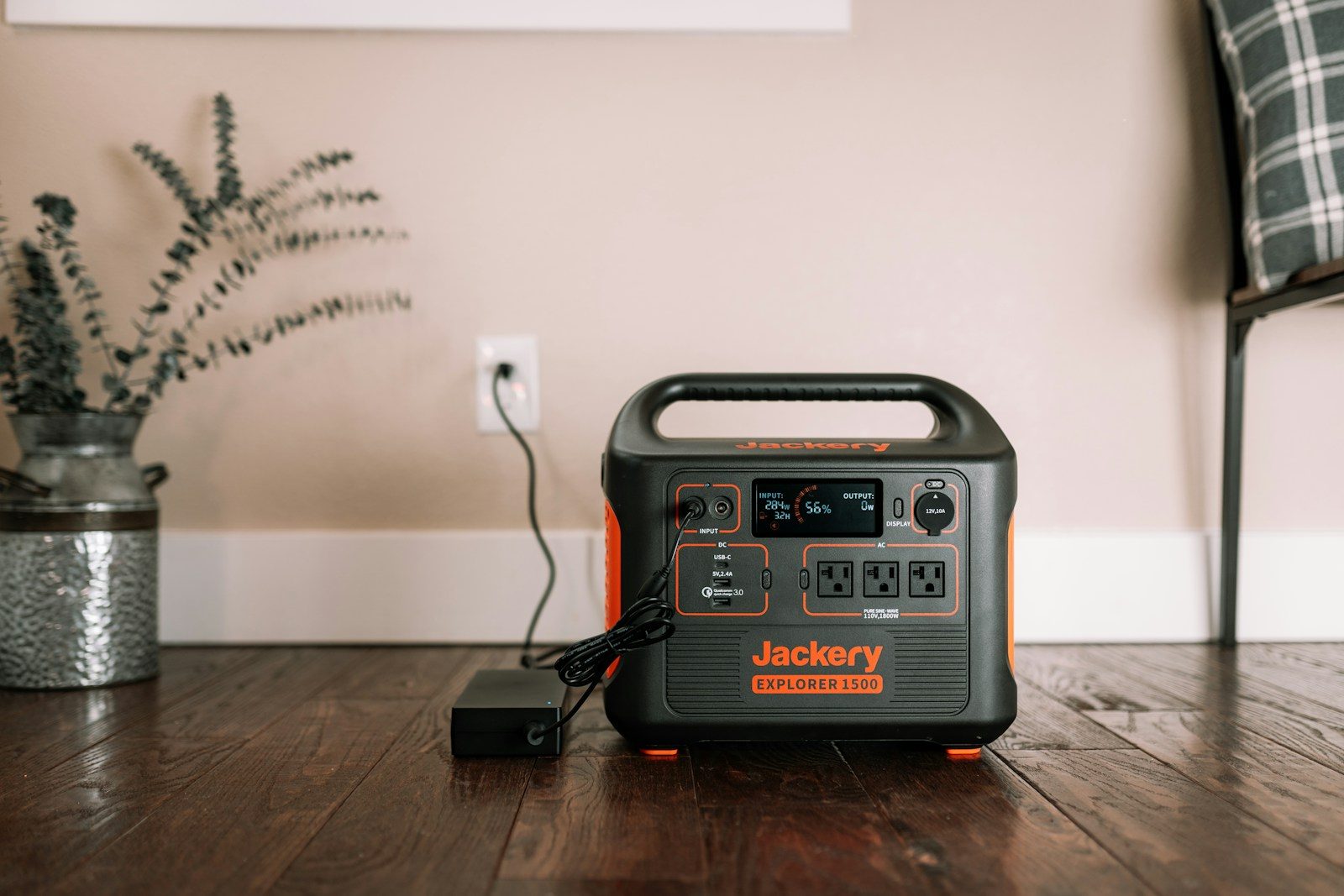
| Portable power station | Selected USB, DC and plug-in appliances | Finite capacity and output; must not feed household wiring |
| Installed home battery with backup capability | Selected circuits or whole-home support within its design limits | High cost, professional installation and backup function may not be standard |
| Portable or standby generator | Longer operation where fuel, outdoor siting and maintenance are practical | Carbon monoxide, fire, noise, fuel storage and electrical-connection risks |
No option is automatically best. A flat needing phone charging has a different risk profile from a rural home with a private-water pump, while medically necessary equipment needs an individual plan rather than a generic shopping recommendation.
Use power banks for phones and small USB loads
A power bank is the simplest first layer of household backup. It is compact, quiet and efficient for charging phones, tablets, rechargeable lights and other compatible USB equipment. Some routers can use USB-C power delivery through the correct manufacturer-approved cable, but voltage, polarity and power negotiation must match.
- Compare the energy rating in watt-hours where it is supplied, not only the large milliamp-hour number printed on the case.
- Check the output protocol and maximum watts needed by each device, including USB-C power delivery profiles.
- Choose enough ports for the planned loads without assuming every port can deliver its maximum simultaneously.
- Keep the correct cables with the power bank and label any cable intended for a particular router or care device.
- Recharge and test the unit at sensible intervals in accordance with its instructions.
Our guide to the best power banks for power cuts compares practical options for keeping communications and small rechargeable equipment working.
Electrical Safety First’s power-bank guidance says lithium-ion units normally become warm during charging or use, but a unit that becomes too hot to handle should be disconnected safely and referred to the manufacturer. Stop using any battery that is swollen, leaking, cracked, unusually hot or giving off an unusual smell or noise.
Choose a portable power station for selected appliances
A portable power station combines a rechargeable battery, charging electronics and outputs that may include USB, 12 volt DC and 230 volt AC sockets. It can run appliances plugged directly into it, provided both the continuous and surge ratings are adequate.
- Capacity: compare watt-hours and look for a clear statement of usable capacity or conversion efficiency.
- AC output: total the loads that may run together and check continuous output, surge output and waveform compatibility.
- DC and USB outputs: direct DC or USB operation may avoid inverter losses when compatible with the equipment.
- Charging: compare mains recharge time, vehicle charging and the permitted solar input voltage, current and wattage.
- Battery and warranty: consider stated cycle life, chemistry, operating-temperature range, warranty and UK after-sales support.
- UPS or pass-through claims: verify transfer time and limitations. A feature described as a UPS may not be suitable for every computer, communications device or medical application.
- Physical use: check weight, handle design, fan noise and whether everyone expected to use the unit can move and operate it safely.
See our comparison of the best portable power stations for home backup when moving beyond phone charging to refrigeration, communications, lighting or other selected appliances.
Plug appliances into the power station exactly as its instructions allow. Do not use a lead with plugs at both ends, do not connect the unit to a wall socket and do not attempt to energise a ring circuit. Electrical Safety First’s current plug-in generation guide specifically warns against plug-in battery systems that feed energy into a grid-connected domestic electrical installation.
Store and charge a portable battery safely
- Use the supplied or manufacturer-approved charger, cables and adapters.
- Charge on a stable surface where heat can dissipate, away from bedding, curtains and combustible clutter.
- Do not charge or store the unit in an escape route, or expose it to water, impact or temperature extremes.
- Do not cover cooling vents or operate the unit inside a closed cupboard unless its instructions expressly permit that arrangement.
- Check the model against the GOV.UK product recalls and alerts service and register it with the manufacturer where possible.
- If a battery smokes, vents gas, hisses or catches fire, move everyone away, leave the building and call 999. Do not carry a failing large battery through the home.
Use a UPS where automatic changeover matters
An uninterruptible power supply can keep compatible equipment running without a manual reconnection when mains power fails. This is useful for a broadband router and fibre ONT, or for giving a desktop computer time to save work and shut down safely.
Check the UPS output in watts as well as volt-amperes, its battery runtime at the intended load and whether the waveform suits the equipment. Small computer UPS units are commonly intended to bridge a brief interruption, not maintain a household service for many hours. Replace their batteries at the specified interval and test the complete setup rather than assuming a green status light proves useful runtime.
Plan an installed home battery and solar backup properly
A fixed battery can shift solar generation or cheaper tariff electricity to another time, but ordinary energy storage and power-cut backup are not the same feature. A grid-connected solar system or battery may shut down when the network fails unless it has been designed to isolate safely from the grid and supply an emergency circuit or the home in island mode.
Energy Saving Trust battery guidance says a typical home system might store 10 kilowatt-hours, although the right size depends on the property and its energy use. Capacity alone does not determine backup performance. The inverter output, surge capability, protected circuits and control arrangement are equally important.
Ask prospective installers to answer these questions in writing:
- Does the quotation include emergency power supply or backup operation during a network outage?
- Will it support selected essential circuits, a dedicated socket or the whole property?
- What continuous and surge power is available when off-grid?
- How quickly does it transfer, and will sensitive equipment restart?
- Can the solar panels continue generating and recharge the battery while the grid remains down?
- Can the system start from a discharged or low battery when sunlight returns?
- What minimum reserve can be held for outages, and how does this affect bill-saving operation?
- Which large loads are automatically excluded or require manual control?
- Where will the battery be installed, and how does the design address ventilation, impact, water and fire safety?
- What inspections, firmware support, warranty cover and end-of-life arrangements are included?
Use an experienced installer certified for the work. The MCS battery-storage guide explains its installation framework, while current UK domestic battery practice incorporates the MIS 3012 installation standard and the PAS 63100 fire-safety specification.
Battery storage and solar PV must also be registered with the relevant Distribution Network Operator. GOV.UK energy-device registration guidance explains that some systems can be notified after installation while others require authorisation before work begins. Confirm that the installer has completed the correct process and retain the certificates, manuals and commissioning information.
Treat a generator as specialist equipment
A generator can provide energy for longer than a battery if fuel remains available, but it introduces exhaust, carbon monoxide, fuel, noise, weather and electrical risks. It is rarely appropriate for a flat, balcony or property without a safe outdoor operating position.
- Operate it outdoors only. Never use a generator in a home, garage, shed, conservatory, crawl space or other enclosed or partly enclosed area.
- Keep exhaust away from the building. Follow the manufacturer’s distances and position it away from doors, windows and air vents where fumes could enter.
- Protect it from water correctly. Do not operate it in rain or standing water. Any weather protection must retain the ventilation and clearances specified by the manufacturer.
- Limit the load. Include motor-starting demand and never exceed the generator’s continuous or surge ratings.
- Refuel cold. Switch off the generator and allow it to cool before adding fuel.
- Store fuel legally and safely. Use approved, labelled containers outside living accommodation and away from heat or ignition sources.
- Use carbon monoxide alarms. Fit battery-powered alarms in the home according to their instructions, but never treat an alarm as permission to operate the generator closer to the building.
The Health and Safety Executive for Northern Ireland’s generator guidance warns that carbon monoxide is colourless and odourless, that partial ventilation is not enough and that fans do not prevent dangerous build-up. It also advises against overloading and says fuel and the generator must remain outside the home.
Appliances may be connected directly only with suitable cables and in accordance with the generator instructions. If a generator will supply fixed circuits, commission a registered electrician to design, install, inspect and test the connection. A suitable changeover and isolation arrangement must prevent the generator feeding electricity back towards the public network. Never use a homemade double-plug lead or improvise at the consumer unit.
If petrol is stored in Great Britain, follow the HSE domestic petrol-storage rules. Up to 30 litres can be kept at home without notifying the local Petroleum Enforcement Authority, but it must be in permitted containers and must not be stored in living accommodation. Larger quantities bring additional notification or licensing requirements. In Northern Ireland, check the applicable requirements with HSENI and the local authority.
Make a separate plan for medical and care equipment
Do not calculate a medical backup from a generic appliance table. Contact the clinical team, care provider, equipment supplier or manufacturer and record the approved power source, battery type, expected runtime, alarms, maintenance procedure and action to take before the backup expires.
- Confirm whether the equipment accepts a portable inverter, DC supply or only its approved battery.
- Include humidifiers, pumps, heated tubing, monitors and communications equipment in the load where they are required.
- Test the backup under controlled conditions according to professional and manufacturer advice.
- Keep emergency contact numbers and the relocation or treatment plan on paper.
- Do not rely on broadband, mobile service or a cordless landline remaining available throughout a regional outage.
Ofgem’s power-cut planning advice recommends checking whether medical equipment has a backup battery and how long it lasts, informing the network operator and supplier, and joining the Priority Services Register where eligible. Registration may provide extra support, but it does not guarantee uninterrupted power or replace a clinical contingency plan.
Build and test a realistic backup-power plan
- List critical loads. Record the exact model, input rating, starting demand and hours required.
- Separate essential from convenient. Protect health, lighting and communication before refrigeration, entertainment, heating or cooking.
- Total simultaneous watts. Include devices that may start automatically and leave headroom below the backup system’s limit.
- Calculate required energy. Multiply each load by its planned operating hours, then allow for conversion losses, cycling and reserve.
- Choose the connection method. Directly connected portable appliances are different from fixed household circuits, which need professional design.
- Plan recharging or refuelling. Consider a multi-day outage, winter solar yield, vehicle-charging limits and legal fuel storage.
- Test safely. Confirm cables, startup, runtime, alarms and user instructions before an emergency.
- Review twice a year. Recharge batteries, install updates, check recalls, rotate suitable fuel and revise the plan when equipment or household needs change.
During an outage, report and track the incident through the network operator. Call 105 free in England, Scotland or Wales, or 03457 643643 in Northern Ireland. Turn off appliances that could restart dangerously, keep fridge and freezer doors closed, and use stored power according to the priorities written in the plan.
Backup power checklist
- Identify essential devices and obtain their real power information.
- Check continuous output, surge output and usable battery capacity.
- Keep power banks for phones and low-power USB equipment.
- Use portable power stations only for directly connected compatible appliances.
- Never feed a wall socket, ring circuit or consumer unit from portable equipment.
- Confirm in writing whether an installed solar battery works during a power cut.
- Use certified installers and retain electrical, building and DNO documentation.
- Operate generators outdoors, away from openings, and store fuel safely.
- Create a separate approved plan for medical and care equipment.
- Test, recharge and review the complete setup twice a year.
UK home backup-power resources
- GOV.UK Prepare power-cut guidance covers outage reporting, communications, appliance precautions, medical planning and vulnerable households.
- GOV.UK emergency preparation guidance recommends torches, a radio, power banks and backup batteries for necessary medical equipment.
- Ofgem’s power-cut plan explains network operators, extra support, medical battery checks and the Priority Services Register.
- Energy Saving Trust battery-storage guidance covers capacity, costs, operating life, installers and combining batteries with solar or tariffs.
- MCS battery-storage guidance explains the technology and how to find a certified installer.
- GOV.UK energy-device registration guidance explains DNO notification, authorisation and installation documents.
- Electrical Safety First’s registered-electrician search helps householders find installers working to the UK electrical safety standard.
- HSENI portable-generator safety guidance covers carbon monoxide, electrical loading, outdoor operation, fuel and fire precautions.
- HSE domestic petrol-storage guidance explains permitted quantities, containers, locations and notification requirements.
- Food Standards Agency power-cut advice explains how to protect chilled and frozen food in England, Wales and Northern Ireland without wasting limited backup energy.
- Food Standards Scotland power-cut advice provides the corresponding guidance for Scottish households.