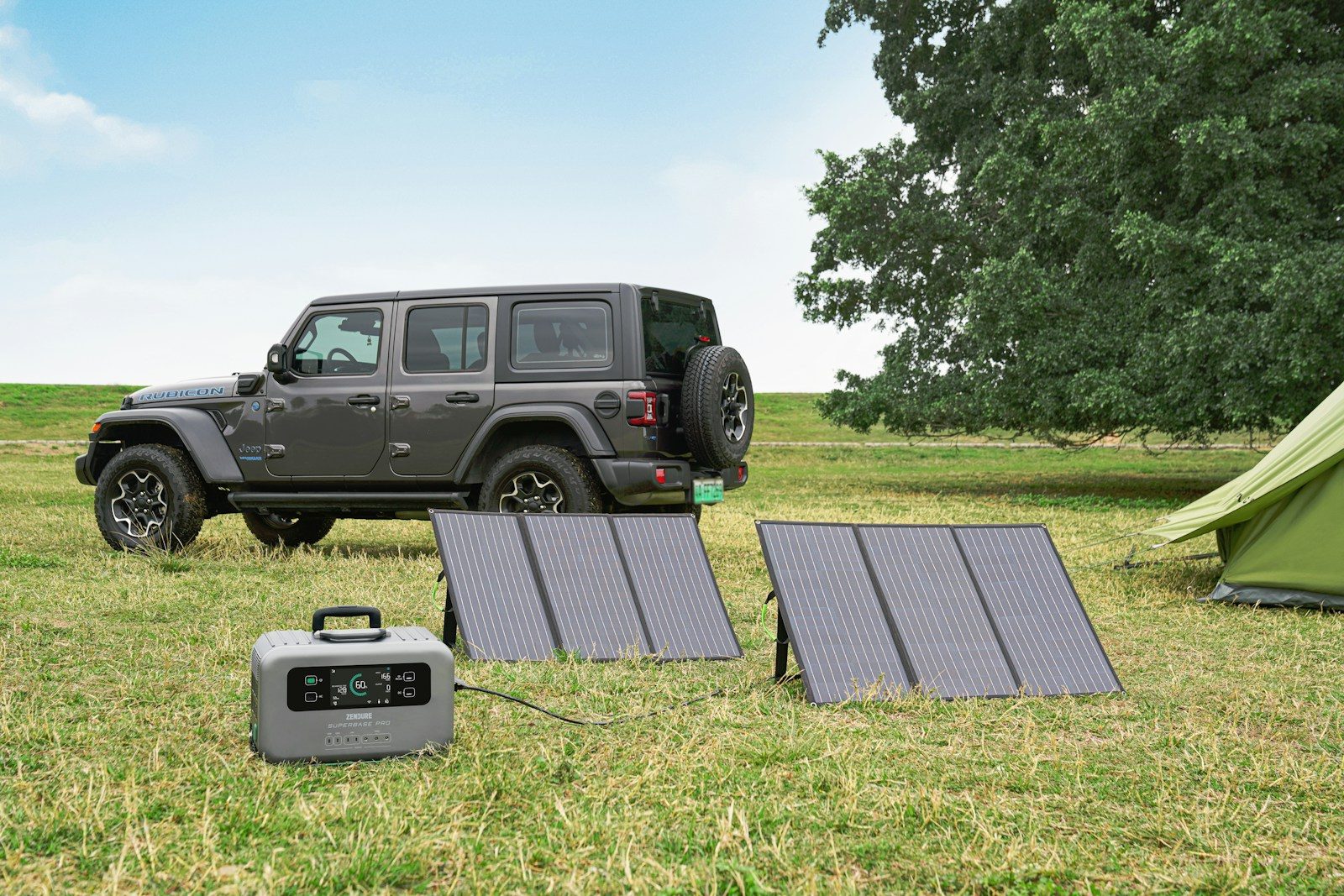
The best portable power stations for home backup are not necessarily the biggest. A sensible unit keeps selected appliances and devices running during a power cut without the fuel, fumes or outdoor siting required by a generator. Capacity should match the job: a router and phones need far less energy than a fridge, pump or kettle. For brief outages, a small UPS, power bank and decent torch may do the job more cheaply. For prices and ordering, click on the product image.
As an Amazon Associate UK Prepared earns from qualifying purchases.
Portable Power Stations for Home Backup – our recommendations
Jackery Explorer 240 v2 Portable Power Station
Small enough to move around the house with one hand, this 256Wh model is suited to routers, phones, lights and laptop charging. Its 300W continuous AC output rules out kettles, heaters and most cooking appliances, but a 100W USB-C port handles many modern laptops directly. Jackery quotes about an hour for an emergency mains recharge, and the unit weighs roughly 3.5kg. There is only one UK AC socket, and solar or car charging accessories may need to be bought separately.
BLUETTI Elite 30 V2 Portable Power Station
The Elite 30 V2 pairs a modest 288Wh battery with a relatively strong 600W continuous inverter, so it can run more small appliances than many units of similar size. It weighs about 4.3kg, provides 140W USB-C output and claims a sub-10ms UPS changeover for compatible equipment. Its advertised 1,500W Power Lifting mode is for suitable resistive loads, not 1,500W continuous output. Runtime remains limited, making this a compact bridge for essential electronics rather than overnight fridge cover.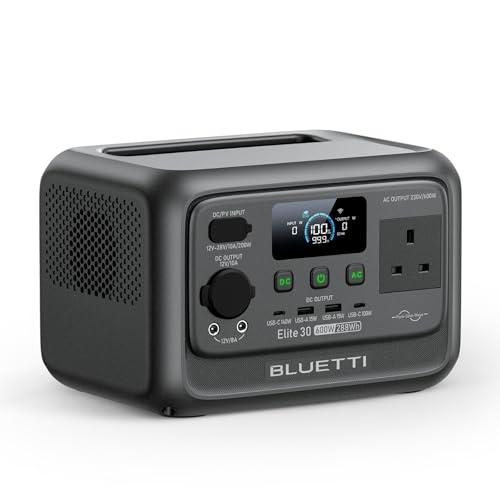
EcoFlow RIVER 3 Plus Portable Power Station
EcoFlow’s base unit holds 286Wh and supplies 600W continuously, with an X-Boost mode for compatible loads. Its strongest home-backup feature is flexibility: the battery can be expanded to 858Wh using stack-on packs, while a quoted sub-10ms changeover suits many routers, computers and network devices. It weighs around 4.7kg and can recharge from the mains in about an hour. The small starting capacity is the compromise, and sensitive equipment should still be checked for UPS compatibility.
DJI Power 500 Portable Power Station
High inverter output in a small chassis is the Power 500’s main appeal. Its 512Wh LFP battery can deliver up to 1,000W, giving more appliance choice than most half-kilowatt-hour competitors, and DJI quotes a 70-minute full mains charge. The compact format suits short outages, workshops and drone users, especially with optional SDC charging accessories. Capacity is still only 512Wh, so a device pulling close to the maximum output will drain it quickly. Think of it as high-power, short-duration cover rather than prolonged backup.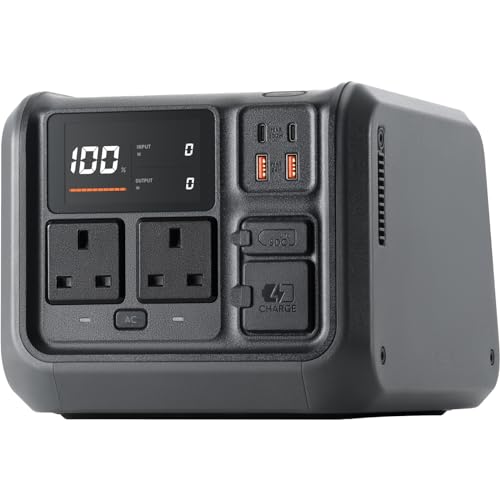
Jackery Explorer 500 v2 Portable Power Station
At 512Wh and roughly 5.7kg, this Jackery prioritises easy handling over raw appliance power. The official continuous AC rating is 500W, with 1,000W peak output, so it works well for communications, lighting, laptops and other modest loads but not a typical kettle. Two AC sockets and a quoted sub-10ms changeover make it more useful around a desk or router cupboard. Fast charging is available, although the quickest figure combines mains and solar input. The relatively low inverter ceiling is the key limitation.
Anker SOLIX C800 Plus Portable Power Station
Anker’s 768Wh C800 Plus is a practical middleweight with 1,200W continuous output, a quoted 58-minute mains recharge and up to 300W solar input. Its two removable camping lights are genuinely handy during a blackout, even if home-only buyers may prefer to spend that money on battery capacity. The 20ms UPS mode can bridge many everyday devices, but compatibility with sensitive equipment is not universal. SurgePad can support selected resistive appliances above the normal rating; it does not turn the unit into a continuous 1,600W supply.
BLUETTI AC70 Portable Power Station
The AC70 is a useful step up for people who want better solar input without moving to a 2kWh unit. It stores 768Wh, delivers 1,000W continuously, accepts up to 500W of solar and can reach 80 per cent from the mains in about 45 minutes under ideal conditions. Weight is roughly 10.2kg, so it remains movable but not light. Its 2,000W Power Lifting claim applies to compatible resistive loads only. Two UK AC sockets may also feel restrictive when several appliances need backup.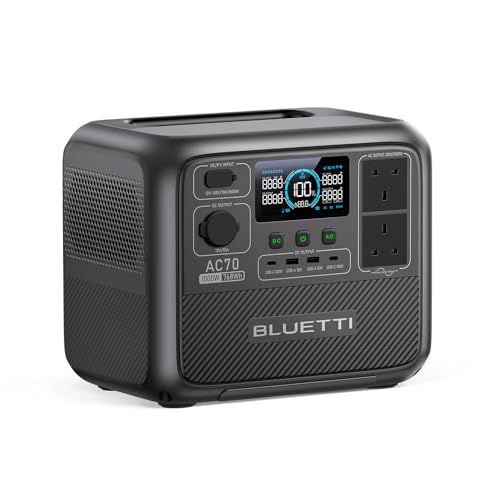
Jackery Explorer 1000 v2 Portable Power Station
With 1,070Wh of capacity and 1,500W continuous AC output, this is a well-balanced choice for a fridge, router, lights and device charging during a moderate outage. It weighs about 10.8kg, has a 100W USB-C port and offers an app-controlled emergency charging mode that can refill the battery in around an hour. The inverter will not cover every high-heat appliance, and the battery is not designed for expansion. Buyers wanting a simple, portable 1kWh box may value that simplicity; growing systems should look elsewhere.
BLUETTI Elite 100 V2 Portable Power Station
BLUETTI fits 1,024Wh and a 1,800W continuous inverter into a chassis weighing about 11.5kg. Up to 1,000W solar input and a quoted 70-minute full recharge make it particularly appealing where fast turnaround matters. It has only two UK AC sockets, which may require careful plug planning, and its 2,700W Power Lifting mode is limited to suitable resistive appliances. The combination of strong output and compact volume is impressive, but the base capacity still gives only about an hour at a sustained 1kW load after conversion losses.
EcoFlow DELTA 3 Plus Portable Power Station
The DELTA 3 Plus is one of the more flexible 1kWh options. It provides 1,800W continuous output, accepts up to 1,000W of solar and is quoted to recharge from the mains in 56 minutes. Extra batteries can raise the system to about 5kWh, allowing a small starting purchase to grow into longer backup. A sub-10ms changeover suits many home-office and networking loads, subject to device compatibility. Expansion batteries add cost and floor space, while the 1,024Wh base unit alone is not whole-home cover.
Anker SOLIX C1000 Gen 2 Portable Power Station
Anker combines a 1,024Wh battery with 2,000W continuous output and 3,000W peak capability, giving this compact unit enough inverter headroom for many kitchen and DIY loads. The app-enabled ultra-fast mode is quoted to reach a full mains charge in 49 minutes, while solar input tops out at 600W. Its high output should not be confused with long runtime: a 2kW load can exhaust a 1kWh battery quickly. The fixed capacity also makes it better for buyers with defined needs than those planning a modular backup system.
DJI Power 1000 V2 Portable Power Station
DJI’s second-generation 1,024Wh model stands out for a 2,600W continuous inverter, unusually high for its capacity. DJI quotes 0-80 per cent charging in 37 minutes and a full charge in 56 minutes. Optional SDC accessories add rapid charging for compatible DJI drones, vehicle charging and other specialist connections. It is a strong fit for short, demanding jobs and drone-heavy households. The trade-off is straightforward: sustained high-power appliances empty 1kWh quickly, and the proprietary accessories increase the cost of using its most distinctive features.
Jackery Explorer 1000 Plus Portable Power Station
Unlike Jackery’s smaller fixed-capacity models, the 1,264Wh Explorer 1000 Plus can grow to roughly 5kWh with three additional battery packs. Continuous output is 2,000W with a 4,000W surge rating, and a full mains charge takes about 1.7 hours. That makes it a credible starting point for modular fridge, freezer and communications backup. It is older and bulkier than the newer Explorer 1000 v2, offers only two UK AC sockets, and becomes expensive once expansion batteries are added.
FOSSiBOT F2400 Portable Power Station
FOSSiBOT offers a lot of capacity for the money: 2,048Wh, 2,400W continuous output, 4,800W surge and three UK AC sockets. The updated model weighs about 22kg, accepts up to 500W solar and lets users reduce mains charging input when a circuit is already busy. It is attractive for longer fridge and freezer cover, although the brand has a shorter UK support track record than several mainstream rivals. Check the actual seller, warranty route and included charging leads carefully before ordering.
Anker SOLIX C2000 Gen 2 Portable Power Station
At about 18.9kg, the C2000 Gen 2 is relatively manageable for a 2,048Wh power station. It supplies 2,400W continuously, peaks at 4,000W and is quoted to recharge fully from the mains in 58 minutes. Anker also emphasises low idle consumption, useful when a router or fridge cycles for many hours. This is a strong self-contained option for households that know 2kWh is enough. It is still heavy to carry upstairs, and rapid charging requires a suitably rated wall circuit with little else drawing power.
Jackery Explorer 2000 v2 Portable Power Station
Jackery’s 2kWh model is notably light for its class at about 17.5kg. The 2,042Wh battery and 2,200W continuous inverter can support a useful mix of cold storage, communications, lighting and occasional higher-power appliances, with 4,400W surge capability for starting loads. A full mains charge is quoted at about 1.7 hours, while an emergency mode can reach 80 per cent faster. The fixed-capacity design keeps operation simple, but it offers no easy route to multi-day storage if needs later grow.
BLUETTI Elite 200 V2 Portable Power Station
The Elite 200 V2 packs 2,073.6Wh of storage behind a 2,600W continuous inverter, with 5,200W surge capability for appliance start-up. That combination suits households wanting a dense, self-contained battery rather than a modular system. Its high output can run demanding equipment, but it cannot make 2kWh last longer; prioritising loads still matters. There are only two UK AC sockets and the model does not accept expansion batteries, so users with many plugs or plans for multi-day autonomy may find the design restrictive.
BLUETTI Apex 300 Portable Power Station
With 2,764.8Wh, 3,840W continuous output and expansion support up to 58kWh, the Apex 300 sits closer to a building-block home energy system than a grab-and-go battery. It can take substantial solar input and has enough inverter capacity for demanding appliances. The trade-offs are weight, price and complexity. The base unit is around 38kg and lacks built-in USB-C ports, which require the optional Hub D1. Any connection to household circuits needs manufacturer-approved transfer equipment and professional installation; ordinary appliances can plug straight into the unit.
Anker SOLIX F3000 Portable Power Station
Anker’s current large-format system stores 3,072Wh and supplies 3,600W, with an EasyTow handle and wheels that make its weight more manageable. One BP3000 expansion battery raises capacity to about 6kWh, and the platform can scale to roughly 12kWh. Up to 2,400W solar input and a quoted 20ms UPS mode support longer interruptions and off-grid recharging. It is expensive and far from hand-portable, but the low-idle design and modular capacity make sense for households moving beyond selected-device backup.
EcoFlow DELTA Pro 3 Portable Power Station
The DELTA Pro 3 provides 4,096Wh, 4,000W continuous output and 8,000W surge, with expansion to around 12kWh and up to 2,600W solar input. It can keep a carefully managed group of household loads running far longer than a 1kWh station. At roughly 51kg, it moves on wheels rather than being carried, and the main unit’s IP20 rating means it needs dry indoor protection. Use approved transfer equipment and a qualified electrician for household-circuit integration. Never backfeed a wall socket.
Portable Power Station Resources
- Ofgem: Plan for a power cut – Official preparation, reporting and compensation guidance.
- Ofgem: Priority Services Register – Extra support for eligible households during supply interruptions.
- Energy Saving Trust: Battery storage – Guidance on battery capacity, efficiency and installed home storage.
- London Fire Brigade: Batteries and chargers – Advice on charging, storage and warning signs of battery damage.
- Electrical Safety First: Products and appliances – Electrical product safety, registration and recall information.
- GOV.UK: Electrical Equipment Safety Regulations – Great Britain rules covering electrical equipment placed on the market.
Click the button below to purchase all of the products in this Portable Power Stations for Home Backup guide from Amazon.
Buy from Amazon.co.ukDisclosure: as an Amazon Associate, UK Prepared earns from qualifying purchases.