For most short power cuts, a 20,000mAh USB-C model gives the best balance of useful reserve, manageable size and cost. Check capacity, maximum single-port output, recharge speed and whether several ports share a much lower total. Rated capacity is not the amount that reaches your phone because conversion consumes some energy. A smaller bank may be enough for one handset, while mains appliances require a proper portable power station. For prices and ordering, click on the product image.
As an Amazon Associate UK Prepared earns from qualifying purchases.
Best Power Banks for Power Cuts – our recommendations
Anker Power Bank (25K, 165W, Built-In and Retractable Cables)
This is a strong all-round reserve for a household that wants to keep laptops as well as phones running. Its 25,000mAh capacity sits just below 100Wh, while three USB-C connections can each supply up to 100W and two ports can share up to 165W. A retractable cable and a shorter built-in cable reduce the chance of finding the battery charged but the right lead missing. It is fairly substantial, and its high output does not make the stored energy last longer.
UGREEN Nexode Power Bank 20000mAh 130W with Built-in USB-C Cable
UGREEN balances useful capacity and serious USB-C output here. The integrated braided cable can deliver up to 100W, while the three outputs share up to 130W, so a compatible laptop, phone and smaller device can be connected together. An 80W input also means the bank need not spend most of the day recharging when mains power returns. The display is helpful for rationing power during an outage. It is more capable than a basic phone bank, though 20,000mAh still means finite runtime under a large laptop load.
INIU P51L-E1 45W Power Bank 20000mAh
At 20,000mAh, the P51L-E1 stores enough for several phone top-ups without becoming an oversized desktop battery. The built-in USB-C cable supplies up to 45W and is joined by USB-C and USB-A ports, allowing three devices to be connected. That output is ample for phones, tablets, handheld consoles and some light USB-C laptop charging. It is a particularly sensible value choice where keeping communications alive matters more than maximum wattage. Multi-device output is shared, so do not expect all three connections to maintain their highest speeds together.
Belkin BoostCharge Pro 3-Port Laptop Power Bank 20K
Belkin’s BPB020 is a straightforward laptop-capable option from an established accessories brand. It holds 20,000mAh, supplies up to 65W Power Delivery from a single USB-C port and includes a second USB-C connection plus USB-A. The colour display reports remaining charge and port activity more clearly than four vague indicator lights. It suits households with a modest USB-C laptop alongside phones and tablets. A 65W ceiling is plenty for many everyday computers, but larger mobile workstations may charge slowly or continue losing power under a heavy workload.
Samsung 20000mAh Battery Pack 45W
Samsung’s EB-P4520 is an uncomplicated match for recent Galaxy devices and other equipment using USB Power Delivery. Its 20,000mAh battery supports 45W Super Fast Charging 2.0 and has three USB-C ports, avoiding the ageing USB-A connections still fitted to many rivals. The same high-speed input helps refill the bank promptly with a suitable charger. This is a tidy choice for an all-USB-C household, especially one with Samsung phones or tablets. Owners of older torches, radios or cables with USB-A plugs will need an adapter or a different bank.
Anker Power Bank (20K, 87W, Built-In USB-C Cable)
The built-in USB-C lead makes this 20,000mAh Anker harder to render useless by misplacing a cable. It can distribute up to 87W across three devices, with up to 65W available to one, which covers many thin laptops as well as phones, tablets and USB lights. A numerical display gives a more useful check of the remaining reserve than a row of LEDs. It is less expensive and easier to justify than the 140W and 165W models if no device needs triple-figure output. As usual, connecting several products reduces the power available to each.
EcoFlow RAPID Pro Power Bank (20,000mAh, 230W, 100W Built-in Cable)
EcoFlow concentrates on running several demanding USB-C devices at once. The 20,000mAh RAPID Pro has a retractable 100W cable, three further USB-C ports and a combined output ceiling of 230W. Its 72Wh capacity is ordinary for this class, so the headline wattage concerns delivery speed rather than longer endurance. The screen and app provide unusually detailed monitoring, useful when every remaining percentage matters. At about 564g it is not a casual pocket bank, and the complete absence of USB-A will inconvenience households with older charging leads.
UGREEN Nexode Power Bank 25000mAh 200W with Smart Digital Display
This Nexode is a useful step up for two-person households or anyone keeping a laptop and several smaller devices available. The 25,000mAh pack has two USB-C ports, one USB-A port and up to 200W combined output, with a TFT display showing charge, input and output data. It is capable of running two high-demand USB-C loads together, yet remains below the 100Wh threshold commonly relevant to air travel. The trade-off is weight at roughly 609g. A 65W maximum input also means it recharges more slowly than some newer premium competitors.
Anker 737 Power Bank (PowerCore 24K)
The long-running Anker 737 remains worth considering because its combination of 24,000mAh capacity, 140W Power Delivery and clear status screen is still practical. Two USB-C ports and one USB-A port cover newer laptops and older accessories, while the display reports input, output and estimated time remaining. At about 630g it is noticeably heavy, and buyers who only need to charge phones would be paying for unused capability. For a laptop that genuinely accepts 100W or 140W USB-C input, however, this is a proven alternative to newer cable-integrated designs.
Baseus Blade H1 Power Bank 20000mAh 100W
The Blade H1 spreads its 20,000mAh cells across a broad, slim case rather than building a thick brick. Two USB-C and two USB-A ports support four connected devices, with up to 100W available from USB-C for a compatible laptop. Its screen shows remaining charge, voltage and current, which helps with outage planning. The flat shape slips neatly beside a notebook computer but occupies more desk and bag area than it first appears. Professional testing has also found it can become warm at full output, so keep it uncovered and ventilated.
CUKTECH 45W Power Bank 20000mAh
CUKTECH’s 20,000mAh model keeps the specification sensible: 45W output, three device connections and a built-in USB-C cable that also forms a carrying loop. That is enough for fast phone and tablet charging, with limited support for smaller USB-C laptops, without the price and weight attached to 140W hardware. The numerical display makes it easier to decide when to stop charging non-essential devices. It is not the right choice for a power-hungry computer, and attaching several products divides the available output, but it is a practical communications and small-device reserve.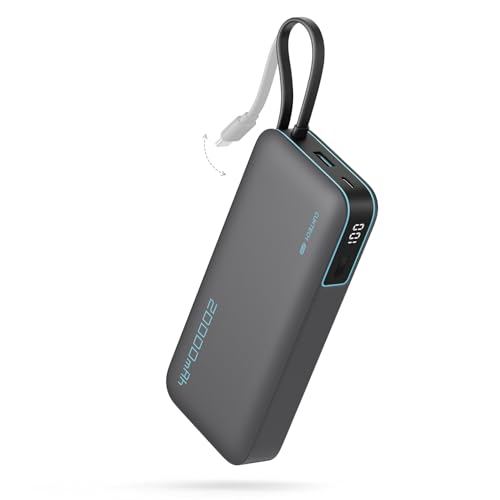
Belkin BoostCharge Power Bank 20K with Display
Not every outage kit needs laptop charging. Belkin’s BPB028 stores 20,000mAh and has two USB-C ports, one USB-A port and a proper percentage display, but limits a single connection to 20W and shared output to 15W. That makes it slower but perfectly adequate for phones, e-readers, headphones and many USB lights. Lower output also discourages paying for performance the household will never use. Choose the 65W BPB020 instead if a laptop matters; choose this one when capacity, familiar ports and simple operation are the priorities.
INIU P50-E1 Power Bank 10000mAh 45W
The P50-E1 is the compact option for someone who wants more than slow emergency phone charging. It combines 10,000mAh with up to 45W output, a percentage display and a detachable USB-C cable that doubles as a short carrying loop. At roughly 160g, it is much easier to keep in a handbag, work bag or coat than a 20,000mAh bank. Capacity is the obvious compromise: it is a personal reserve, not a family outage supply. Its output can top up tablets and handheld consoles, but sustained laptop use will empty it quickly.
Anker Nano Power Bank (10K, 45W, Built-In Retractable USB-C Cable)
Anker’s Nano suits regular everyday carry that also serves as a short power-cut backup. The 10,000mAh pack includes a retractable USB-C cable of about 70cm, another USB-C port, USB-A and a smart display. Either USB-C connection can supply up to 45W alone, while the bank accepts up to 30W when being refilled. It weighs about 232g, appreciably more than the INIU P50-E1, but the longer captive cable is more convenient at a desk. Combined output falls to 22.5W, so its headline speed applies to one device.
Duracell 10000mAh Power Bank
This Duracell is a basic 37Wh reserve for households that want recognisable controls and no elaborate feature set. Its USB-C port supplies up to 15W, USB-A reaches 12W and both can be used together for two small devices. That is sufficient for routine phone charging, an e-reader or many USB accessories, although it lacks the speed and numerical display of newer rivals. The modest specification is the point: it is easier to justify as a spare kept charged for occasional cuts. Look elsewhere for laptops, fast Samsung charging or several days of supply.
Xtorm Xtreme Power Bank Rugged 35W 20000mAh
The XR202 is built for a rougher setting than the average glossy battery. Its 20,000mAh pack carries an IP65 water-resistance rating, a built-in torch and four outputs, including a 35W USB-C connection and legacy USB-A. This makes sense in a damp outbuilding, vehicle kit or outdoor work bag where physical protection matters more than minimum weight. It can also pass power through while recharging. The rugged housing and premium price are unnecessary for a bank that never leaves a drawer, and 35W is not enough for every laptop.
Goal Zero Venture 75 Power Bank
Goal Zero’s Venture 75 combines 19,200mAh, a 60W bidirectional USB-C port, two USB-A outputs and a 50-lumen torch. The IP67 rating is the important distinction, protecting against dust and temporary immersion when the port cover is secured. It is a convincing choice for flood-prone storage areas, camping gear or field work, but weighs about 577g and costs more than ordinary 20,000mAh banks. Goal Zero advises recharging it every three to six months in storage, a useful reminder that even an emergency battery needs a maintenance routine.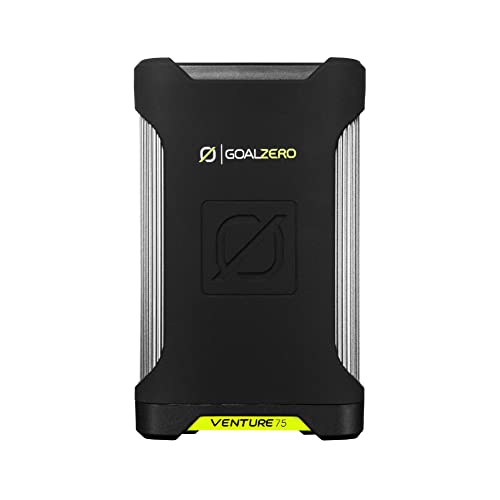
BioLite Charge 80 PD
The Charge 80 PD is an older but still useful 20,000mAh design aimed at travel and outdoor equipment. One USB-C port and two USB-A outputs allow three connections, while its 74Wh battery weighs about 465g. Output is limited to 18W in total, so this is better suited to phones, head torches, GPS units and radios than modern laptops. The restrained power specification looks dated beside cheaper 45W models, but buyers with a collection of USB-A cables may value the layout. It can also accept an 18W solar-panel input when suitable equipment is available.
UGREEN Nexode Power Bank 20000mAh 67W with Built-in USB-C Cable
This 67W Nexode occupies a useful middle ground between phone-only banks and expensive high-output models. Its 20,000mAh capacity, captive USB-C cable, separate USB-C port and USB-A connection cover three devices, while either USB-C route can supply up to 67W alone. At about 393g, it is lighter than many laptop-capable rivals in this guide. It is a good fit for a slim laptop and phone, provided their combined demand is modest. The built-in cable is convenient, though damage to any captive lead is harder to remedy than replacing a separate one.
Duracell M150 Portable Charging Hub
The M150 is closer to a portable charging hub than a pocket bank. Its 25,000mAh, 91Wh battery feeds two USB-C ports, two USB-A ports and a wireless phone holder, while a dimmable ring light is genuinely useful during a blackout. The supplied dock encourages everyday charging, which reduces the risk of discovering an empty emergency battery. At roughly 816g it belongs on a desk or bedside table, not in a coat pocket. Despite the 150W rating, it has no UK mains socket and cannot replace a power station for household appliances.
Power Banks for Power Cuts Resources
- Electrical Safety First power bank guidance – Practical advice on buying, charging, handling and recognising an overheating or damaged power bank.
- UK product safety alerts, reports and recalls – Search the official database before buying or continuing to use a particular power bank model.
- National Grid tips to prepare for a power cut – A concise household checklist, including keeping devices charged and knowing how to report an outage.
- Ofgem plan for a power cut – Explains reporting, vulnerable-household planning, medical equipment backup and possible compensation.
- Ofgem Priority Services Register – Details the free extra support available from energy suppliers and network operators to eligible households.
- UK Civil Aviation Authority baggage guidance – Current rules for carrying power banks, watt-hour limits and protection against short circuits when flying.
- GOV.UK battery and electrical recycling guidance – Explains where to take rechargeable batteries and why lithium battery terminals should be protected for recycling.
Click the button below to purchase all of the products in this Best Power Banks for Power Cuts guide from Amazon.
Buy from Amazon.co.ukDisclosure: as an Amazon Associate, UK Prepared earns from qualifying purchases.