
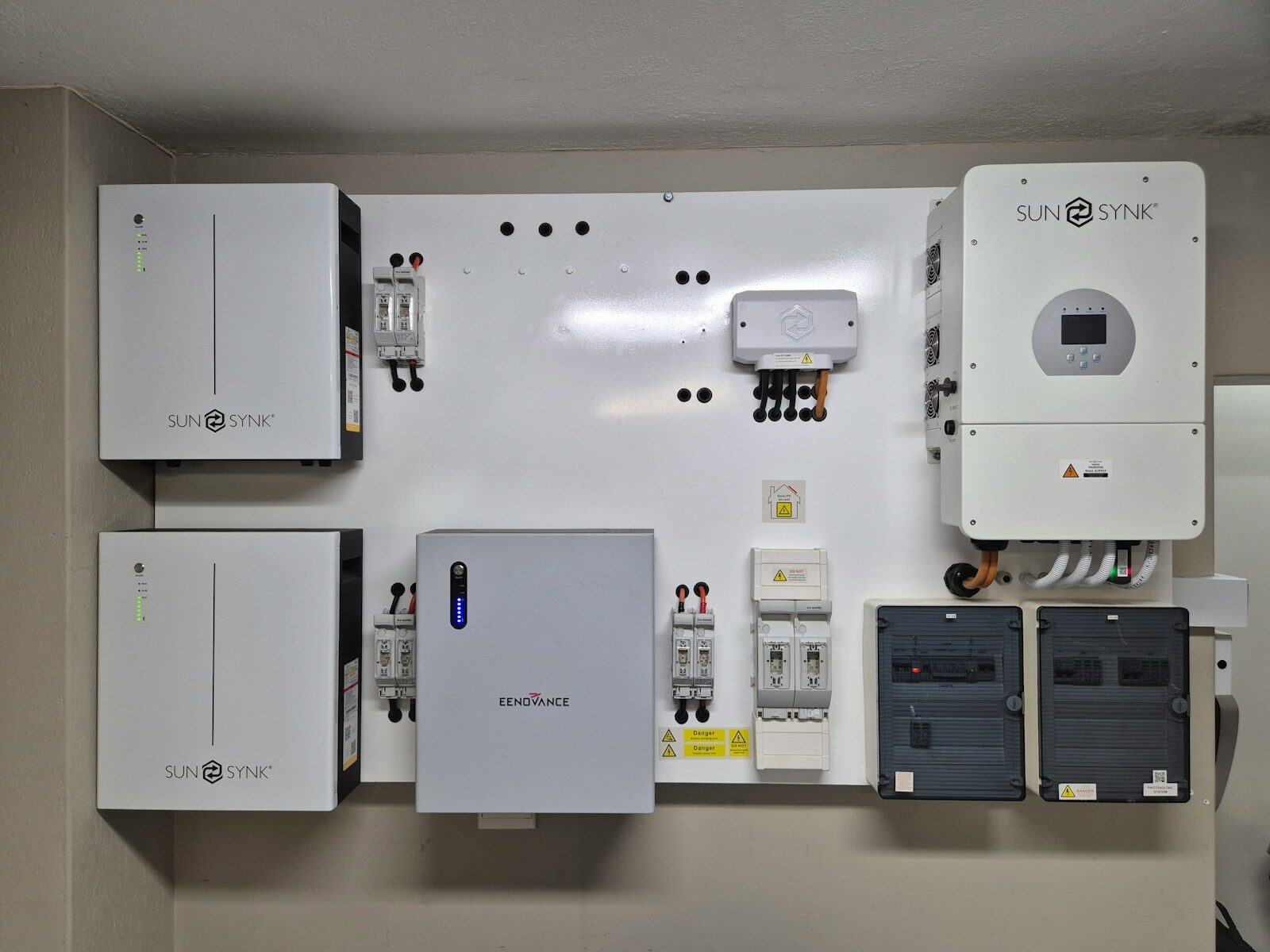
This home battery size calculator helps you estimate the capacity in kilowatt-hours and output in kilowatts needed for selected backup loads, solar self-use or time-of-use tariff shifting. Complete the worksheet with measured household data, then ask a competent installer to verify the result against the property, electrical installation and proposed equipment.
This is a planning estimate, not an electrical design or installation specification. A home battery must be selected, located, connected and commissioned by people with the appropriate competence. Battery capacity alone does not confirm that the system can power a home during a power cut.
Use the UK Prepared guide to measuring electricity use at home before entering estimated loads. If you already own a battery and want to estimate runtime, use the Backup Battery Runtime Calculator. The home backup-power guide explains the differences between portable and permanently installed systems.
Home battery size calculator: choose the job first
| Planning goal | Primary figure to measure | Use this section |
|---|---|---|
| Power selected circuits during an outage | Energy used by the selected loads across the planned outage | Calculator A |
| Shift surplus solar electricity into the evening | Electricity needed after solar generation falls, limited by surplus available to charge | Calculator B |
| Shift cheaper electricity into a dearer tariff period | Electricity used during the period you want the battery to cover | Calculator B |
| Combine daily shifting with a protected outage reserve | Daily shifting energy plus the reserve that must remain unused | Calculator A and B |
| Back up most or all of the home | Interval consumption, maximum demand, starting loads and circuit design | Use this estimate only as an installer brief |
Capacity and output are different. Kilowatt-hours, written kWh, measure stored energy and affect runtime. Kilowatts, written kW, measure power at a particular moment and determine which loads can operate together. A battery can have enough energy for the day but still be unable to start or run a high-power appliance.
Before entering figures
- ☐ Decide whether the calculation is for outage backup, daily energy shifting or both.
- ☐ List only the circuits and equipment that the proposed system is intended to support.
- ☐ Measure cycling or variable equipment over a representative period where possible.
- ☐ Use rated watts only as an estimate when measured consumption is unavailable.
- ☐ Record which loads may operate at the same time.
- ☐ Record motor, compressor and pump starting requirements from reliable technical information.
- ☐ Keep electric showers, immersion heaters, electric ovens, EV charging, resistance heating and other large loads separate until an installer confirms that they belong in the design.
- ☐ Do not assume that solar panels will recharge the battery during a power cut. Confirm that the proposed system supports solar generation while operating in island mode.
- ☐ Do not assume that an ordinary grid-connected battery provides backup. Confirm the islanding arrangement, maintained circuits, changeover method and earthing design.
Calculator A: battery size for power-cut backup
Step 1: calculate load energy
For a fixed or reasonably steady load, use:
Load energy in kWh = watts x quantity x total operating hours during the outage ÷ 1,000
For equipment that cycles or varies its power, such as refrigeration, use measured kWh over a representative period and scale it to the planned outage. Do not multiply a compressor’s rated running watts by 24 hours unless it genuinely runs continuously.
| Selected load | Quantity | Average or measured watts | Total operating hours | Energy needed, kWh |
|---|---|---|---|---|
| ________________ | ______ | ______ W | ______ h | ______ kWh |
| ________________ | ______ | ______ W | ______ h | ______ kWh |
| ________________ | ______ | ______ W | ______ h | ______ kWh |
| ________________ | ______ | ______ W | ______ h | ______ kWh |
| ________________ | ______ | ______ W | ______ h | ______ kWh |
| ________________ | ______ | ______ W | ______ h | ______ kWh |
| ________________ | ______ | ______ W | ______ h | ______ kWh |
| Total load energy | ______ kWh |
Step 2: add an allowance
An allowance can cover measurement uncertainty, inverter standby consumption, battery ageing, temperature effects or a modest extension to the planned outage. Do not add the same loss twice if it is already included in a manufacturer or installer figure.
Adjusted load energy = total load energy x (1 + allowance percentage ÷ 100)
| Calculation line | Your figure |
|---|---|
| A. Total load energy | ______ kWh |
| B. Chosen design allowance | ______ % |
| C. Adjusted load energy: A x (1 + B ÷ 100) | ______ kWh |
Step 3: convert the load into battery capacity
Battery specifications use terms such as nominal capacity, usable capacity and usable energy differently. Ask the installer to confirm whether the quoted usable figure is measured at the battery or represents AC energy available to the maintained loads. Use only one of the following methods.
Method 1, confirmed usable AC energy:
Number of battery units = adjusted load energy ÷ confirmed usable AC energy per unit
Round the result up to the next compatible whole module. Do not apply a second depth-of-discharge or inverter deduction if the confirmed figure already represents AC energy delivered through the backup output under the stated conditions.
Method 2, nominal battery capacity:
Available discharge fraction = (expected starting state of charge – minimum permitted state of charge) ÷ 100
Required nominal capacity in kWh = adjusted load energy ÷ available discharge fraction ÷ delivery efficiency
Enter percentages as decimals in the final calculation. For example, 90% becomes 0.90. Use a delivery-efficiency figure that applies from stored battery energy to the AC backup loads. Do not substitute a published round-trip efficiency unless the manufacturer or installer confirms that it is appropriate.
| Calculation line | Your figure |
|---|---|
| C. Adjusted load energy | ______ kWh |
| D. Expected state of charge when an outage begins | ______ % |
| E. Minimum permitted state of charge | ______ % |
| F. Available discharge fraction: (D – E) ÷ 100 | ______ |
| G. Confirmed delivery efficiency as a decimal | ______ |
| H. Required nominal capacity: C ÷ F ÷ G | ______ kWh |
If the battery may be partly discharged when the grid fails, use the expected starting state of charge or configure and preserve a suitable emergency reserve. Line D must be greater than line E. A calculation that assumes a full battery does not guarantee that a full charge will be available at the start of an unplanned outage.
Step 4: check continuous and starting power
Add the running power of every load that may operate at the same time. The battery system and backup inverter must support at least this continuous demand. Then check the highest credible short starting demand from compressors, pumps, motors and other relevant equipment against the system’s stated surge capability and permitted surge duration.
| Power check | Your figure | Installer or system limit | Pass? |
|---|---|---|---|
| Highest simultaneous running load | ______ W | ______ W continuous | Yes / No |
| Highest expected starting demand | ______ W | ______ W for ______ seconds | Yes / No |
| Highest single maintained-circuit load | ______ W | ______ W | Yes / No |
| Maximum permitted backup output | ______ kW | Confirmed by installer | Yes / No |
Worked example: selected loads for 48 hours
This example uses illustrative household measurements to demonstrate the arithmetic. It is not a recommended appliance allowance or a suggested battery size.
| Example load | Calculation basis | Energy for 48 hours |
|---|---|---|
| Fridge-freezer | Measured 0.8 kWh per day x 2 days | 1.600 kWh |
| Router and fibre terminal | 18 W x 48 hours ÷ 1,000 | 0.864 kWh |
| LED lighting | 30 W x 10 total hours ÷ 1,000 | 0.300 kWh |
| Phone charging | 20 W x 4 total hours ÷ 1,000 | 0.080 kWh |
| Boiler controls and pump | 120 W x 16 total hours ÷ 1,000 | 1.920 kWh |
| Total load energy | 4.764 kWh |
- Add a 20% example allowance: 4.764 kWh x 1.20 = 5.7168 kWh, rounded to 5.72 kWh.
- Assume the battery starts at 100% and stops discharging at 10%: (100 – 10) ÷ 100 = 0.90 available discharge fraction.
- Assume 92% delivery efficiency for this example: 0.92.
- Calculate nominal capacity: 5.7168 ÷ 0.90 ÷ 0.92 = 6.90 kWh when rounded to two decimal places.
- Select the next compatible capacity above the result, then verify output, surge, location, connection and backup operation with the installer.
If a manufacturer instead confirms that each unit delivers a stated amount of usable AC energy through the backup output, compare that figure directly with the 5.72 kWh adjusted load requirement and round up to a compatible number of modules.
The power check remains separate. In this example, if the fridge is drawing 150 W while the router, lighting, phone charging and boiler equipment draw 18 W, 30 W, 20 W and 120 W, the simultaneous running load is 338 W or 0.338 kW. The inverter must also accommodate the fridge and pump starting demands, which cannot be inferred from their average energy use.
Calculator B: battery size for solar or tariff shifting
For everyday use, size the battery around the electricity you can realistically move from one period to another. Total daily consumption alone can overstate the useful battery size. Use smart-meter, supplier, solar-inverter or sub-meter data from representative days and seasons.
| Date or day type | Energy used in target period | Surplus solar or cheap-rate energy available | Energy worth shifting |
|---|---|---|---|
| ________________ | ______ kWh | ______ kWh | ______ kWh |
| ________________ | ______ kWh | ______ kWh | ______ kWh |
| ________________ | ______ kWh | ______ kWh | ______ kWh |
| ________________ | ______ kWh | ______ kWh | ______ kWh |
| ________________ | ______ kWh | ______ kWh | ______ kWh |
| ________________ | ______ kWh | ______ kWh | ______ kWh |
| ________________ | ______ kWh | ______ kWh | ______ kWh |
- Choose a representative high-use day rather than relying only on an annual daily average.
- Set the usable energy target to the amount you genuinely expect to shift, limited by both later demand and energy available for charging.
- Check whether the battery can charge during the available window: average charge power in kW = charging energy in kWh ÷ charging-window hours.
- Check whether it can discharge quickly enough during the target period: average discharge power in kW = delivered energy in kWh ÷ discharge-period hours.
- Ask the installer to model seasonal solar generation, tariffs, export limits, standby use, conversion losses and battery controls.
If the target is 6 kWh delivered to the home and the confirmed round-trip efficiency is 90%, the charging source must provide approximately 6.67 kWh because 6 ÷ 0.90 = 6.67. If that charging must occur within four hours, the required average charging rate is approximately 1.67 kW before considering system limits or changing power during the charge cycle.
Combining daily use with an emergency reserve
A battery used every day may be partly discharged when a power cut begins. If a fixed emergency reserve must remain available, treat it as capacity that is not available for routine tariff or solar shifting.
Combined usable capacity target = daily shifting allocation + protected emergency energy
| Combined-use calculation | Your figure |
|---|---|
| Daily usable energy to shift | ______ kWh |
| Protected usable emergency energy | ______ kWh |
| Combined usable capacity target | ______ kWh |
| Configured backup reserve | ______ % or ______ kWh |
| Expected reserve remaining at grid failure | Confirmed / Not confirmed |
Do not subtract hoped-for solar generation from the protected emergency requirement unless the system is designed to recharge from solar while isolated from the grid and the installer has modelled credible low-generation conditions.
Result check: what the estimate does and does not prove
| Result | What it tells you | What still needs verification |
|---|---|---|
| Required usable energy, kWh | Approximate energy that must reach the intended loads | Definition used in the product specification |
| Required nominal capacity, kWh | Estimated headline capacity after stated assumptions | Usable operating range, temperature and ageing |
| Continuous output, kW | Loads that may run together | Per-phase limits, inverter and circuit design |
| Starting or surge output, kW | Short motor or compressor demand | Supported power, duration and load compatibility |
| Charge rate, kW | Whether the battery can refill in the available period | Battery, inverter, tariff, solar and network limits |
| Backup duration | Estimated runtime at the planned load | Actual starting charge, changing loads and weather |
Home battery installer brief
| Question or requirement | Information to record |
|---|---|
| Primary purpose | Backup / solar self-use / tariff shifting / combined |
| Calculated usable energy target | ______ kWh |
| Calculated nominal capacity | ______ kWh using stated assumptions |
| Highest simultaneous running load | ______ kW |
| Known starting or surge loads | ________________________ |
| Circuits to remain powered | ________________________ |
| Loads deliberately excluded | ________________________ |
| Required outage duration | ______ hours or ______ days |
| Emergency reserve setting | ______ % or ______ kWh |
| Backup or island mode included | Yes / No / To confirm |
| Solar can operate in island mode | Yes / No / To confirm |
| Manual or automatic changeover | ________________________ |
| Expected usable capacity at end of warranty | ______ kWh |
| Proposed battery location | ________________________ |
| DNO process and responsibility | ________________________ |
| Building and electrical certificates supplied | ________________________ |
| Commissioning test of backup circuits | Date and result: ________________________ |
Cases needing individual assessment
- Medical or care equipment: agree a separate outage plan with the clinical team, care provider or equipment supplier. Do not rely on this generic calculation as the sole protection for life-sustaining equipment.
- Electric heating and heat pumps: include controls, circulation pumps, defrost behaviour, auxiliary heaters and cold-weather demand where applicable.
- Private water, sewage or drainage pumps: verify starting current, duty cycle, water storage and the consequences of a failed start.
- Three-phase homes: ask the installer how backup output is distributed and which loads or phases remain supplied.
- Flats and rented homes: obtain the required permissions and confirm suitable access, fire precautions, cable routes and equipment location.
- Outdoor, garage or unheated locations: use the manufacturer-approved temperature range and any capacity or power derating that applies.
- Solar during an outage: confirm compatible island-mode operation, black-start behaviour, maximum solar input and what happens when the battery is full or empty.
- Future expansion: confirm module compatibility, inverter limits, warranty conditions and whether later additions require further network approval.
Home battery resources and official guidance
- Energy Saving Trust battery-storage guidance explains typical household uses, capacity in kWh, efficiency losses and the value of installer advice.
- MCS Battery Installation Standard MIS 3012:2025 sets requirements for MCS contractors designing, installing and commissioning electrical energy storage systems.
- GOV.UK energy-device registration guidance explains battery-storage registration, installer responsibilities, DNO processes and documentation.
- Energy Networks Association connection guides explain the G98 and G99 routes used for distributed generation and storage connections.
- Electrical Safety First’s BS 7671 Amendment 4 pocket guide summarises current domestic electrical-installation changes, including stationary battery installations.
- GOV.UK domestic battery safety research reviews lithium-ion home-storage risks and measures used to reduce them.
- GOV.UK Prepare power-cut guidance covers household preparation, communications and planning for powered medical equipment.