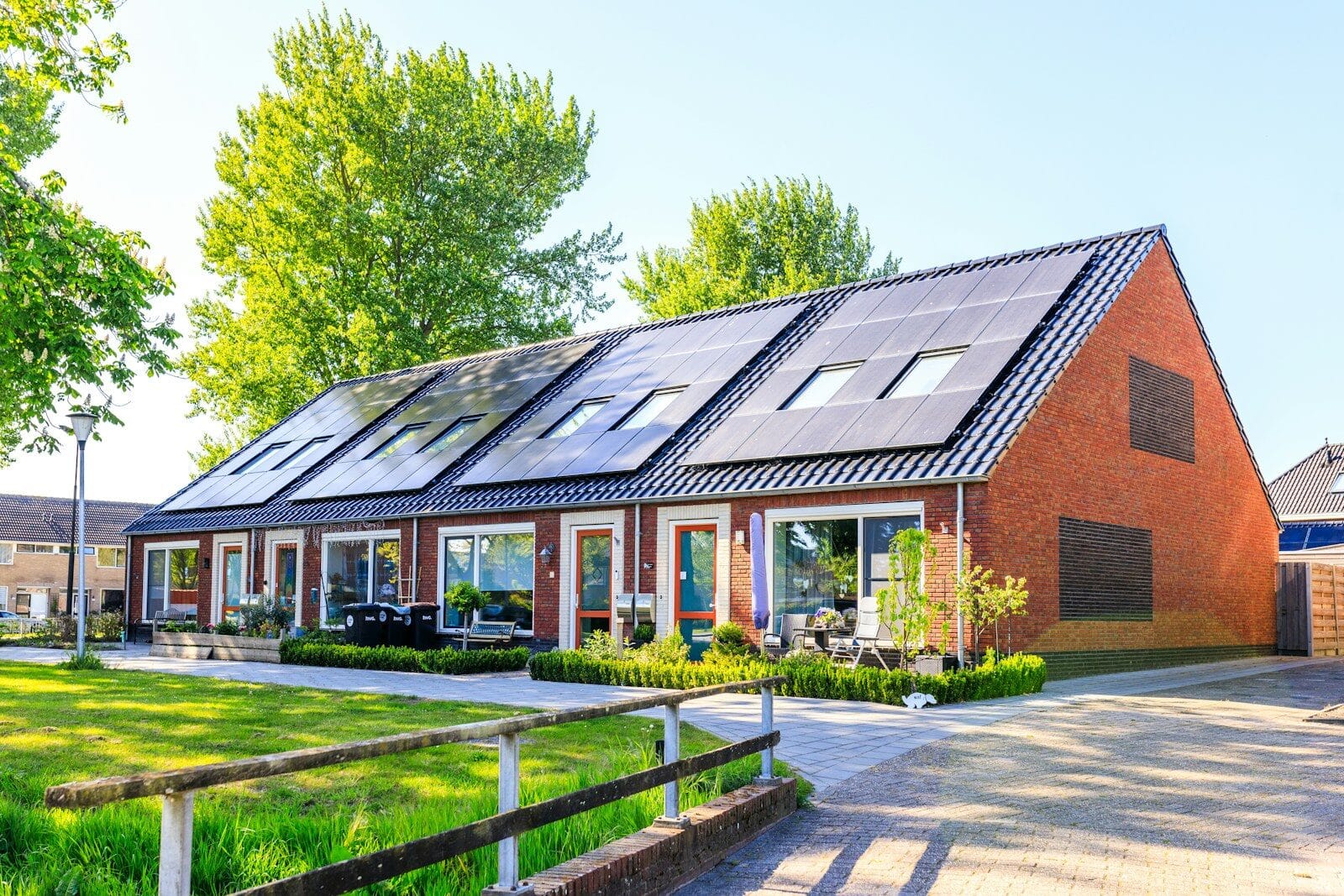
Most solar panels do not power a UK home during a power cut. A standard grid-connected solar PV system is designed to stop supplying electricity when the grid fails, even if the sun is shining. A normal solar battery may also stop supplying the home.
Solar can keep selected circuits, or sometimes most of a home, running only when the installation includes compatible equipment that safely disconnects it from the public network and operates it in island mode. This capability must be designed, installed and commissioned deliberately. It should never be assumed from the presence of solar panels or a battery.
When do solar panels work during a power cut?
| Solar or battery arrangement | Normally works in a grid power cut? | What remains available? |
|---|---|---|
| Standard grid-connected rooftop solar | No | No household solar supply until the grid returns |
| Rooftop solar with an ordinary grid-connected battery | Not necessarily | Nothing unless backup operation was included in the design |
| Solar, battery and a correctly designed island-mode system | Yes, within its limits | Specified backup circuits or the home, depending on the installation |
| Off-grid solar installation | Yes, within its limits | Loads supported by its inverter, battery and available generation |
| Great Britain-compliant plug-in solar connected to a home socket | No | The device is designed to switch off during the cut |
| Portable solar panel connected to a compatible portable power station | Yes, independently of the grid | Devices connected safely to the power station |
The Energy Saving Trust’s current solar guidance confirms that solar panels typically cannot power a home during a cut and that battery storage also needs additional equipment and configuration. The word battery therefore does not mean backup.
Why does a standard solar system shut down?
Solar panels produce direct current electricity. A grid-connected inverter converts it into alternating current that matches the public electricity supply. When the grid disappears or moves outside permitted voltage and frequency limits, the inverter disconnects.
This automatic protection prevents a domestic system from energising network cables while engineers may believe they are isolated. It also prevents an ordinary grid-following inverter from trying to support household wiring without the stable electrical reference and protective arrangements it expects from the grid.
The result can seem surprising: sunlight may still be reaching the panels, but the inverter stops making usable household AC electricity. The panels have not necessarily failed. The system is responding to the loss of the grid as designed.
What is island mode?
Island mode allows part or all of an electrical installation to operate as a small independent system after it has been disconnected from the public network. Sales material may describe this as backup mode, emergency power supply, EPS, backup output or whole-home backup. Those labels alone do not describe what the system can actually do.
The Institution of Engineering and Technology’s island-mode guidance explains that the power-conversion equipment must disconnect from the grid when the grid supply is lost. Safe island operation also requires appropriate switching, earthing and protection arrangements.
A typical backup-capable installation may include:
- Solar PV panels and a compatible solar or hybrid inverter.
- Battery storage with sufficient usable energy and output power.
- An islanding or backup arrangement that separates the maintained circuits from the grid.
- Suitable neutral, earthing, residual-current and overcurrent protection.
- A dedicated backup consumer unit or clearly identified maintained circuits, unless the system was designed for whole-home operation.
- Controls that manage solar generation, battery charging, household demand and reconnection when the grid returns.
This is fixed electrical installation work. It should be designed and installed by competent professionals, not assembled through adapters, improvised leads or changes to the consumer unit by the householder.
A home battery is not automatically a backup battery
Many batteries are installed to store excess solar electricity or cheaper off-peak grid electricity. They may work every day to reduce bills yet still switch off when the grid fails. Backup needs compatible power-conversion equipment, isolation and an installation designed to supply maintained loads safely.
The current MCS battery installation standard distinguishes systems with and without an islanding arrangement. It defines a backup isolator as equipment that disconnects the grid supply from the battery system and maintained loads during island operation.
Will the solar panels recharge the battery during an outage?
They can, but only if the system has been designed to keep the solar generation operating in island mode and to charge the battery safely. Some backup arrangements can use solar throughout an outage. Others provide battery power but cannot restart or continue the solar inverter once the grid has failed.
Do not infer this feature from the battery capacity, hybrid-inverter label or the presence of a backup socket. Ask the installer to state in writing whether the solar panels can:
- continue generating immediately after the grid fails;
- restart the following morning after the battery has reached its lower limit overnight;
- recharge the battery while simultaneously supplying the backed-up circuits;
- control excess generation safely when the battery is full and household demand is low.
These details matter during a multi-day outage. A system that supplies the home from a charged battery for one evening but cannot use the panels to recharge it is battery backup, not continuing solar resilience.
Whole-home backup and essential-circuit backup are different
An essential-circuit system supplies a limited group of loads, often lighting, refrigeration, communications and selected sockets. Whole-home backup connects more of the installation, but that does not mean every appliance can be used at once.
| Load type | Typical backup priority | Design issue to check |
|---|---|---|
| Router, optical-network terminal and phone charging | High for communications | Continuous low-power supply and transfer interruption |
| Fridge or freezer | Often high | Starting surge as well as normal running power |
| Lighting | High | Which circuits are maintained |
| Boiler controls and circulation pumps | Situation-dependent | Electrical compatibility, starting power and fuel availability |
| Medical or care equipment | Health-critical | Manufacturer guidance, dedicated plan and alternative arrangements |
| Electric shower, oven, immersion heater or resistive space heating | Usually unsuitable for limited backup | Very high demand and rapid battery depletion |
| Heat pump or water pump | Property-dependent | Running load, starting current and installer-approved operation |
The inverter’s output power, usually expressed in kW, limits how much can run at one time. Battery capacity, expressed in kWh, affects how long those loads can run. A large battery paired with a low-power backup output may last for hours but still be unable to start a pump or supply a high-demand appliance.
How long will a solar battery run the home?
Runtime depends on usable battery energy, the average backed-up load, conversion losses, the minimum state of charge and any solar generation available during the cut.
Approximate runtime in hours = usable battery capacity in kWh divided by average load in kW
For illustration, 5 kWh of genuinely usable energy divided by a steady 0.5 kW load gives 10 hours before allowing for conversion losses or any protected reserve. Real loads cycle on and off, and motors can draw more power when starting, so an installer should check both energy and peak output.
Use the backup battery runtime calculator to compare realistic loads. Winter performance also deserves particular attention. Solar panels still generate in winter, but shorter days, weaker sunlight, cloud and shade can leave much less energy available than a summer estimate suggests.
How to check whether an existing solar system has backup
Do not test an unknown installation by removing service fuses, altering fixed wiring or creating a fault. Start with the system documents and ask the original installer or another competent solar and battery specialist.
- Find the inverter and battery make, model, manuals, electrical certificates and commissioning documents.
- Look for an identified backup output, backup gateway, changeover equipment or separate consumer unit. A label is evidence to investigate, not proof of the final capability.
- Check which circuits are listed as maintained during island mode.
- Ask for the continuous output, short-duration peak output, usable battery capacity and minimum reserve setting.
- Confirm whether solar generation can continue and restart while the grid remains unavailable.
- Confirm the transfer behaviour. Equipment such as computers or medical devices may restart if the changeover is not interruption-free.
- Ask the installer to demonstrate the approved test procedure and show every household member how to recognise backup mode.
If the paperwork only describes self-consumption, tariff charging or export, do not assume backup was installed. The app showing energy in a battery is also not proof that sockets will remain live during an outage.
Can an existing solar system be upgraded for power cuts?
Often it can, but the work and cost depend on the existing inverter, battery compatibility, consumer unit, earthing arrangement, cable routes, intended loads and network connection. Possible designs include adding a compatible battery and backup gateway, replacing the inverter, or creating a separate maintained-loads consumer unit.
A retrofit quotation should not simply say that EPS is included. It should name the maintained circuits, output limits, transfer behaviour, battery reserve, solar-recharging behaviour and test process. It should also explain what will stop working during backup mode.
Solar PV, battery storage and material changes to the connection must follow the appropriate network process. GOV.UK guidance for Great Britain explains DNO registration and when installers must notify after installation or obtain approval before work. Northern Ireland uses its own network procedures.
Our guide to whether solar power is worth it for a UK home covers the wider financial decision. The separate guide to backup power for a UK home compares installed batteries with power banks, portable power stations, uninterruptible power supplies and generators.
What about plug-in and portable solar panels?
Plug-in solar and portable solar charging are not the same arrangement.
- Plug-in solar connected to a household socket: current Energy Saving Trust plug-in solar guidance says compliant devices are designed to switch off during a power cut. They do not keep the socket circuit live.
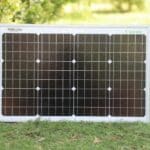
- Portable panel connected to a power station: this is separate from the grid. A compatible panel can charge the power station during an outage, and the station can supply devices connected to its own outlets within its ratings.
A portable power station must not be connected to a household wall socket to energise fixed wiring. Never use a cable with plugs at both ends. Keep the setup portable unless a competent professional has installed an approved changeover arrangement.
Our buying guides cover portable solar panels for power stations and portable power stations for home backup. Check the panel’s connector, open-circuit voltage, operating voltage and current against the power station’s solar-input limits. Wattage alone does not establish compatibility.
What to do when the power goes off
- Check whether the outage affects the area and report it to the network operator.
- Follow the solar and battery manufacturer’s instructions rather than repeatedly resetting the inverter.
- Confirm which backup circuits are live before connecting or switching on loads.
- Turn off ovens, electric fires, irons, immersion heaters and other high-demand equipment that could overload the backup system or restart unexpectedly.
- Prioritise lighting, communications, refrigeration and health-related equipment.
- Watch battery state of charge and reduce demand early if the outage may continue overnight.
- Keep away from damaged lines, flooded electrical equipment and exposed cables.
The UK Government’s power-cut guidance says to call 105 in England, Scotland and Wales or 03457 643643 in Northern Ireland when online reporting is unavailable. It also advises turning off appliances that could create danger or suffer surge damage when power returns.
For an outage that may last overnight or longer, use the planning steps in how to prepare for a longer power cut and check the power cut supplies checklist. Solar backup should support a wider household plan, not replace food, water, warmth, lighting and communication preparations.
Do not rely on solar alone for medical equipment
A solar battery may be one part of a medical power plan, but cloud, equipment faults, depleted storage and loads exceeding the inverter limit can still interrupt it. The Government advises people who use powered medical equipment to make a plan with their care provider, clinical team and equipment supplier.
Confirm the device manufacturer’s power requirements, acceptable transfer interruption and approved backup method. Arrange a clear response if the battery reaches its lower limit or the solar system fails. Eligible households should also join the appropriate Priority Services Register or, in Northern Ireland, the relevant Customer Care Register.
Questions to ask before buying solar backup
- Does the quoted system operate in island mode during a grid failure?
- Which exact circuits and sockets remain powered?
- What are the continuous and peak output limits in backup mode?
- How much battery energy is usable during an outage?
- Can the solar panels continue or restart without the grid?
- Can solar supply loads and recharge the battery at the same time?
- What happens when the battery is full, empty or below its reserve setting?
- Is the transfer interruption short enough for every critical device?
- What isolation, earthing and protective equipment will be installed?
- Who completes building-control, electrical-certification and network-registration work?
- How is backup mode tested, and how often should the household repeat that test?
- What warranties and maintenance arrangements cover the inverter, battery and backup equipment?
The useful question is not simply whether the home has solar panels. It is whether the complete installation can disconnect safely, form a stable local supply, support the required loads and replenish its battery under realistic UK conditions. Get those capabilities in writing before treating solar as power-cut protection.
Solar power-cut resources
- Energy Saving Trust’s solar power fact check explains why normal solar and battery systems require additional equipment to work during an outage.
- The IET’s island-mode guidance explains grid disconnection, switching, earthing and protection for electrical energy storage systems.
- MCS battery installation standard MIS 3012 covers battery-system design, islanding arrangements, maintained loads, installation and commissioning.
- GOV.UK energy-device registration guidance explains DNO notification and approval for solar PV and battery storage in Great Britain.
- Energy Saving Trust battery-storage guidance covers capacity, costs, operating life, installers and everyday use with solar or time-of-use tariffs.
- Energy Saving Trust plug-in solar guidance explains current Great Britain rules and confirms that compliant plug-in systems switch off in a power cut.
- Electrical Safety First’s plug-in solar consumer guide covers protective devices, competent electrical assessment, prohibited connections and current warnings about plug-in battery storage.
- UK Government power-cut guidance explains preparation, reporting numbers, appliance safety, medical planning and support for people with additional needs.