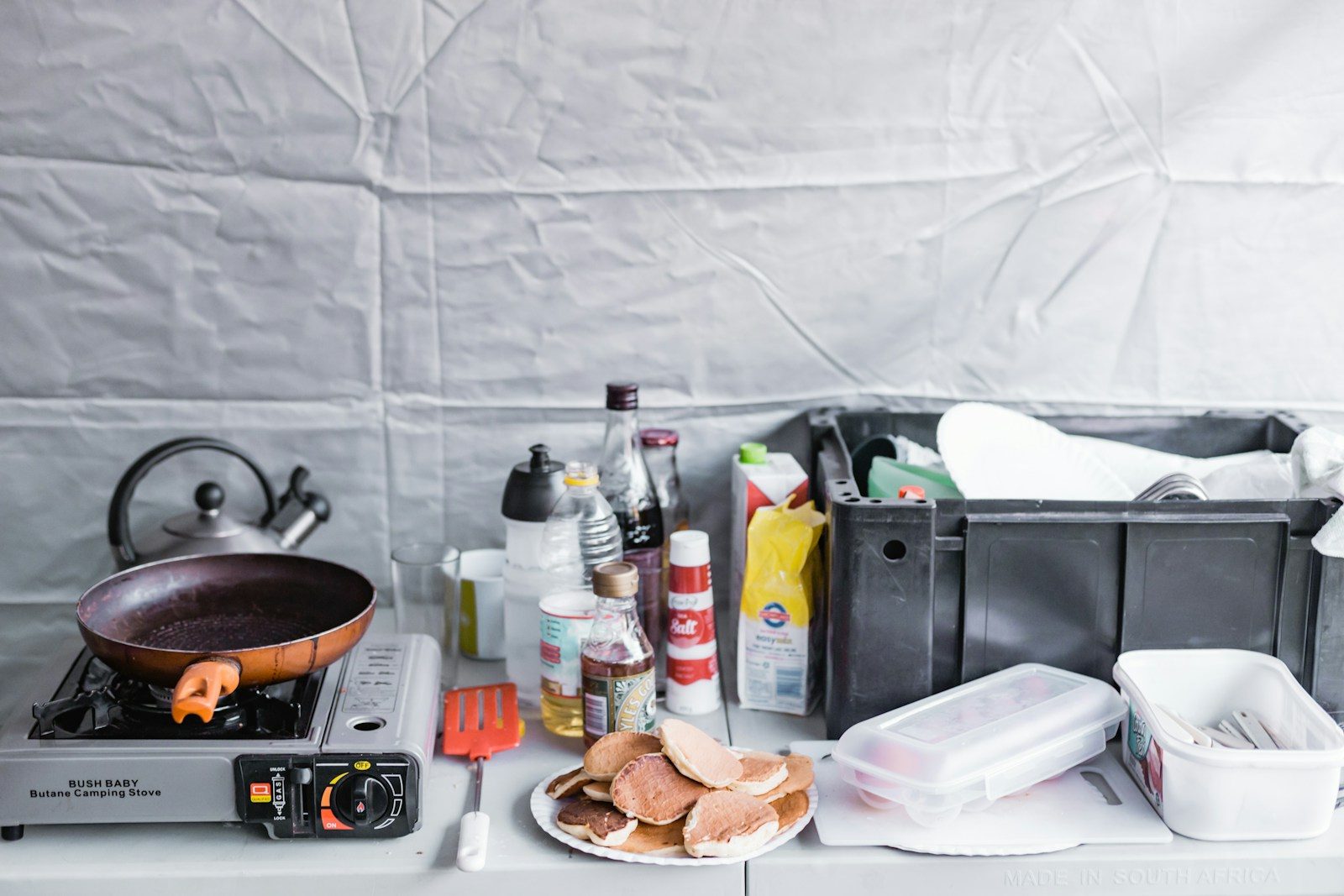
The safest emergency cooking plan starts with food that can be eaten cold, followed by an existing indoor appliance that is designed for household cooking and still has a safe power or gas supply. A portable power station can run some electric appliances if its output and battery capacity are sufficient. Camping stoves, bottled-gas stoves, barbecues and charcoal burners must normally be used outdoors, exactly as their manufacturers instruct.
Never bring a barbecue, camping stove, charcoal burner or outdoor gas appliance into a house, flat, garage, shed, conservatory or tent. These appliances can cause a fire and produce deadly carbon monoxide. Opening a window or relying on a carbon monoxide alarm does not make indoor use safe.
Decide whether cooking is necessary
A short power cut does not automatically require an alternative cooker. Opening the fridge or freezer to find ingredients can allow cold air to escape, while setting up unfamiliar equipment creates unnecessary fire, scalding and carbon monoxide risks.
Use this order of preference:
- No-cook food: choose food that is safe to eat directly from its packaging.
- An existing indoor appliance: use a functioning gas hob or another installed cooker only as its manufacturer permits.
- A battery-powered electric appliance: use a suitable appliance with a correctly rated portable power station.
- Outdoor cooking equipment: use a camping stove or barbecue only in a genuinely open outdoor location where its instructions allow.
Do not take avoidable risks simply to produce a hot meal. Sandwiches, cereal, tinned food, crackers, fruit and other ready-to-eat supplies are perfectly reasonable during a temporary outage. The guide to foods that do not need refrigeration suggests suitable cupboard options.
Check the power cut before preparing food
Confirm that the problem is a power cut rather than a fault affecting only your home or one appliance. Switch off unattended cooking equipment that was operating when the electricity failed. An electric oven or hob may restart when power returns if its controls remain switched on.
- Check the distribution board without removing any covers.
- Look for official information from the electricity network operator.
- Unplug unnecessary appliances to reduce the load when power returns.
- Leave one light switched on so that you know when electricity has been restored.
- Use a battery torch or lantern to illuminate the cooking area.
- Keep naked flames away from temporary lighting, batteries and fuel.
If there is smoke, burning, arcing, floodwater near electrical equipment or another immediate danger, do not attempt to cook. Leave the affected area and contact the emergency services when necessary.
Protect refrigerated and frozen food first
The Food Standards Agency’s power-cut guidance says an outage lasting less than four hours is unlikely to affect the safety of chilled or frozen food. Keep the doors closed as much as possible.
A fridge should remain cold for up to four hours. A full freezer may keep food frozen for up to 48 hours, or approximately 24 hours when half full, although these are estimates rather than guarantees. Appliance design, starting temperature, room temperature and how often the door is opened all affect the result.
Use a fridge thermometer if possible. During a power cut, chilled food can remain stored below 8°C. If the fridge reaches 8°C or above, food that normally requires refrigeration should be eaten within four hours or discarded. Cooking does not rescue food that has already become unsafe.
The full guide to keeping food safe during a power cut explains the fridge, freezer and disposal rules in more detail.
Use food in the right order
If the outage continues, prioritise food according to its storage needs rather than automatically opening tins from the emergency cupboard. The Food Standards Agency recommends this general order:
- Food that needs refrigeration and remains safe to eat.
- Defrosted frozen food that does not require cooking.
- Perishable food stored at room temperature.
- Shelf-stable canned, bottled and dried food.
Only cook chilled or defrosted food if you have enough power or fuel to complete the cooking process and can serve it immediately. Do not partially cook raw meat with the intention of finishing it much later.
Which cooking methods can be used during a power cut?
| Cooking method | Where it may be used | Main limitation |
|---|---|---|
| No-cook food | Indoors | Check whether an opened pack requires refrigeration. |
| Existing gas hob | Indoors, if designed and approved for normal household use | Some models require electricity for ignition, controls or safety systems. |
| Electric appliance powered by a portable power station | Indoors, following both appliance manuals | The power station must support the appliance’s input power and operating time. |
| Camping or bottled-gas stove | Outdoors only unless the manufacturer explicitly specifies a different safe location | Fire, carbon monoxide, fuel and weather risks. |
| Gas or charcoal barbecue | Outdoors only | High fire and carbon monoxide risk, including after cooking has finished. |
| Installed solid-fuel cooker or stove | Only in its approved installed location | Requires a maintained flue, suitable fuel and correct operation. |
| Petrol or diesel generator | The generator must remain outdoors | Carbon monoxide, fire, fuel and electrical-connection risks. |
An appliance being portable does not mean it is safe in every location. Read its instructions before an emergency and retain the manual with the equipment.
Can a gas cooker work during a power cut?
A gas cooker may continue to work, but this depends on its design. Some hobs use mains electricity only for the spark ignition, while other cookers rely on electricity for gas valves, fans, timers, ovens or safety controls.
Do not assume that a gas ring can be lit manually. Check the appliance manual in advance and use manual ignition only if the manufacturer expressly permits it. Do not bypass an ignition system, flame-failure device or electrical interlock.
- Use only an installed appliance intended for indoor household cooking.
- Keep permanent ventilation openings clear.
- Remember that an electric extractor fan will not operate unless it has backup power.
- Keep pans stable and turn their handles away from edges.
- Never leave a lit burner unattended.
- Turn every control fully off when cooking is complete.
- Never use a gas hob or oven to heat the room.
If the gas fails to ignite, turn it off and follow the manufacturer’s instructions. If you smell gas, do not operate electrical switches or create a flame. Leave the property when necessary and call the National Gas Emergency Service on 0800 111 999.
Using a portable power station for cooking
A portable power station can run some ordinary electric cooking appliances without producing combustion fumes. However, heating food and boiling water consume substantial amounts of power. The appliance must be compatible with the power station’s AC output, continuous power rating, surge rating and available battery capacity.
Read the appliance’s input power from its rating label. For a microwave, do not confuse the advertised cooking output with the higher electrical input shown on the label.
| Appliance | Indicative input power | Power-cut considerations |
|---|---|---|
| Electric kettle | Often 2,000 to 3,000W | Fast, but its high power may exceed a smaller inverter. |
| Microwave | Often 1,000 to 1,600W input | Efficient for short reheating, but may have a high starting demand. |
| Single induction hob | Often 1,000 to 2,000W | Adjustable, but requires compatible cookware and substantial inverter output. |
| Electric hotplate | Often 1,000 to 2,000W | Simple but comparatively slow and remains hot after switching off. |
| Rice cooker | Often 300 to 800W | Lower power than a kettle, but runs for longer. |
| Slow cooker | Often 100 to 300W | Low power but long cooking time requires enough battery for the complete cycle. |
These are broad planning ranges, not specifications for every appliance. Check the exact rating label before connecting anything. A 2,000W appliance cannot be used merely because the battery contains 2,000Wh. The power station must also be able to deliver the required watts continuously.
The backup battery runtime calculator can estimate operating time after allowing for conversion losses. If you need a larger system, the portable power stations for home backup buying guide compares suitable categories and features.
- Place the power station on a firm, dry and ventilated surface.
- Keep it away from flames, hot pans, steam and cooking splashes.
- Do not cover its cooling vents.
- Connect the appliance directly where the manufacturer recommends this.
- Do not overload an extension lead or multi-socket adaptor.
- Stop if the power station or plug becomes unusually hot, smells abnormal or reports a fault.
- Never connect a portable power station to a household wall socket to energise the home’s wiring.
Use the battery efficiently by boiling only the water required, covering pans, heating one-pot meals and switching appliances off immediately after use. A vacuum flask can keep surplus hot water available without repeatedly running the kettle.
Camping stoves and barbecues must stay outdoors
The London Fire Brigade’s cooking-safety guidance states that outdoor cooking equipment such as barbecues and camping stoves must not be used indoors. The danger is not removed by opening a door or window.
Outdoor means a genuinely open location. It does not mean:
- a garage with its main door open;
- a shed or greenhouse;
- a conservatory;
- a porch or enclosed passage;
- a tent, awning or gazebo with enclosed sides;
- a balcony; or
- a room beside an open window.
The London Fire Brigade’s barbecue guidance recommends level ground away from sheds, fences, trees and anything else that could catch fire. It also warns against balconies, decking, enclosed spaces and unattended cooking.
- Follow the appliance and fuel manufacturer’s instructions exactly.
- Place the stove on a stable, level and non-combustible surface.
- Keep it well away from doors, windows, vents and the building.
- Keep children, pets and loose clothing away from the cooking area.
- Never leave it unattended while lit or hot.
- Do not use oversized or unstable pans.
- Do not use an improvised windshield that traps heat around the fuel container.
- Never change or refill fuel beside a flame or hot appliance.
- Allow the equipment to cool completely before moving or storing it.
Do not move outdoor equipment indoors after cooking. Charcoal and smouldering ashes can continue producing carbon monoxide for hours, even when they appear to be extinguished.
Understand the carbon monoxide risk
Carbon monoxide is colourless and has no smell. It can be produced by appliances and fires that burn gas, wood, oil, petrol, diesel or coal. The NHS carbon monoxide guidance specifically warns that barbecues, camping stoves and portable generators can cause carbon monoxide to accumulate when used inside or in an enclosed space.
Possible symptoms include:
- headache;
- dizziness;
- feeling or being sick;
- weakness or unusual tiredness;
- confusion;
- chest or muscle pain; and
- shortness of breath.
Symptoms may improve outside and return when the person re-enters the affected building. If carbon monoxide exposure is suspected, stop using the appliance if it is safe to do so, get everyone into fresh air and seek medical help. Call 999 if anyone has difficulty breathing, sudden confusion, weakness, chest pain or loss of consciousness.
Fit audible carbon monoxide alarms in rooms containing appliances that burn gas, oil, coal or wood, following the alarm manufacturer’s placement instructions. The London Fire Brigade carbon monoxide guide recommends alarms certified to BS EN 50291. An alarm provides a warning, but it does not make an outdoor cooker safe to use indoors.
Do not run a generator indoors
A petrol, diesel or LPG generator produces exhaust and must not be operated inside a home, garage, shed, cellar, conservatory or other enclosed space. Position it outdoors as directed by its manufacturer, with the exhaust facing away from the home and away from doors, windows and vents.
Do not improvise a connection into household wiring and never feed power through a wall socket. Any fixed generator connection requires correctly designed changeover equipment installed by a competent electrician. For simple emergency cooking, a self-contained battery power station is usually less complicated than a combustion generator.
Choose meals that use little fuel, power and water
Emergency meals should be simple, familiar and quick to prepare. Store food that can be eaten cold as well as food that needs only brief heating.
| Meal type | Example ingredients | Resources required |
|---|---|---|
| No-cook breakfast | Cereal, UHT milk, fruit or breakfast bars | None beyond clean utensils |
| No-cook lunch | Crackers, nut or seed butter, tinned fish, tinned fruit | Manual can opener if required |
| Quick hot meal | Ready-to-eat rice pouch with tinned beans or curry | Brief reheating |
| Hot-water meal | Couscous, instant noodles, soup or porridge | Measured quantity of boiling water |
| One-pot meal | Tinned vegetables, pulses and ready-cooked grains | One pan and short heating time |
Avoid designing the whole emergency menu around dried rice, pasta or pulses. These can require substantial water and prolonged cooking. Ready-to-eat versions consume less fuel and preserve drinking water.
Use the emergency food calculator to estimate quantities, then record the actual foods, equipment and opening instructions on the emergency food storage checklist.
Cook food thoroughly
Alternative equipment can heat unevenly or more slowly than a normal cooker. Food must still be cooked completely. The Food Standards Agency’s cooking guidance recommends following packet or recipe instructions and checking that food is steaming hot throughout.
If using a clean food thermometer, the middle of the food should reach one of the official equivalent temperature and time combinations, including:
- 70°C for 2 minutes;
- 75°C for 30 seconds; or
- 80°C for 6 seconds.
Poultry, pork, minced meat, burgers, sausages, kebabs, rolled joints and offal must be cooked thoroughly. If you cannot confirm that the equipment can complete the cooking safely, choose a ready-to-eat alternative.
Avoid leftovers when refrigeration is unavailable
Prepare only the amount that will be eaten immediately. A large pan may save fuel per portion, but it creates a food-safety problem if the remaining food cannot be cooled and refrigerated promptly.
- Choose tins, cartons and pouches that can be finished in one meal.
- Do not leave cooked food sitting in a warm pan for later.
- Do not repeatedly warm and cool the same food.
- Reheat leftovers only once and until steaming hot throughout.
- Discard perishable leftovers if safe refrigeration is unavailable.
Do not rely on cold outdoor weather without measuring the temperature and protecting the food. The Food Standards Agency says food may be stored outside when the temperature is below 8°C, provided it is kept in clean, dry conditions, away from sunlight and protected from animals in a sealed box.
Maintain hygiene with limited water
Wash hands before preparing food and keep raw ingredients separate from cooked or ready-to-eat food. If the water supply is also affected, use stored drinking-quality water for food preparation and follow the advice in how to store drinking water safely.
- Use alcohol-based hand sanitiser when hands are not visibly dirty.
- Use suitable antibacterial wipes or sprays on preparation surfaces.
- Keep separate utensils and plates for raw and cooked food.
- Clean a food-thermometer probe between uses.
- Open tins with a clean manual can opener.
- Do not wash raw chicken or other poultry.
- Keep rubbish and discarded food away from the preparation area.
If a boil-water, do-not-drink or do-not-use notice is in force, follow the water supplier’s instructions. Do not assume that a domestic filter jug makes the water suitable for cooking.
Prepare separately for infant formula
Powdered infant formula requires reliable water heating and careful hygiene. The NHS formula-preparation guidance says freshly boiled drinking water should be allowed to cool for no more than 30 minutes so it remains at a temperature of at least 70°C when mixed with the powder.
If water cannot be boiled safely, ready-to-feed liquid formula can be a more practical emergency option. Store it according to its label, prepare each feed hygienically and discard formula left in the bottle after feeding.
What should be in an emergency cooking kit?
- Food that can be eaten without cooking.
- A manual can opener.
- A small pan with a well-fitting lid.
- A kettle or other appliance matched to the backup power supply.
- A vacuum flask for safely holding hot water.
- A clean food thermometer.
- Battery-powered task lighting.
- Oven gloves and heat-resistant utensils.
- Matches or an appropriate lighter, stored securely if required by approved equipment.
- Alcohol-based hand sanitiser and suitable surface wipes.
- Working smoke, heat and carbon monoxide alarms.
- A written one-day and three-day meal plan.
- The manuals for every cooker, stove and backup-power device.
Test the meal plan during normal conditions. Confirm that the household likes the food, the manual can opener works, the cookware fits the appliance and the planned energy or fuel supply is sufficient.
What to do if cooking causes a fire
Never throw water onto a burning pan of oil or fat. The London Fire Brigade’s pan-fire guidance says not to tackle or move the pan. Turn off the heat only if it is safe, leave the room, close the door, warn everyone else and call 999.
Do not take personal risks to save the meal, appliance or property. Your priority is to get everyone out and keep the escape route clear.
Emergency cooking checklist
- Keep fridge and freezer doors closed initially.
- Use no-cook food before setting up alternative equipment.
- Check whether a gas cooker is permitted to operate without electricity.
- Never bypass cooker ignition or safety systems.
- Match electric-appliance input power to the backup supply.
- Confirm that the battery can complete the planned cooking cycle.
- Use camping stoves and barbecues outdoors only.
- Never cook with outdoor equipment in a garage, shed, tent or conservatory.
- Keep generators outdoors and away from building openings.
- Maintain working smoke, heat and carbon monoxide alarms.
- Cook food until it is steaming hot throughout.
- Keep raw and ready-to-eat food separate.
- Avoid leftovers if refrigeration is unavailable.
- Use safe drinking water for cooking and cleaning.
- Know the symptoms of carbon monoxide poisoning.
Emergency cooking resources
- Food Standards Agency power-cut advice covers refrigeration times, food-use priorities, alternative cooking equipment and hygiene.
- Food Standards Agency cooking guidance explains visual checks, thermometer use, cooking temperatures, meat safety and reheating.
- London Fire Brigade cooking-safety guidance covers alarms, supervision, cooking fires and the indoor dangers of outdoor equipment.
- London Fire Brigade barbecue guidance explains outdoor positioning, supervision, cooling and carbon monoxide risks.
- London Fire Brigade carbon monoxide guidance covers fuel-burning appliances, alarms, ventilation, symptoms and emergency action.
- NHS carbon monoxide advice explains symptoms, possible sources and when to call NHS 111 or 999.
- NHS infant-formula guidance explains water heating, hygiene and the use of ready-to-feed formula.