This emergency food storage checklist helps you test whether your household reserve is complete, safe and genuinely usable during disruption. Mark each item as ready, needs action or not applicable. Build supplies gradually from familiar foods that your household already eats and replace items through normal use.
This is a stock and storage audit, not a fixed shopping list. Household needs vary. Follow food labels, allergy information and any advice from a clinician, dietitian, health visitor or vet. Store drinking water separately and include any water needed for food preparation.
For more background, use this checklist with the UK Prepared emergency food storage guide and emergency water planning guide.
Emergency food storage checklist: check these first
- ☐ The household has chosen the number of days it wants the food reserve to cover: ______ days.
- ☐ Everyone who may be at home is included, including children, guests who regularly stay and anyone receiving care.
- ☐ The reserve contains planned meals and snacks, not just a collection of unrelated tins and packets.
- ☐ The core supply is shelf-stable, ready to eat and does not depend on electricity, gas, refrigeration or a large amount of preparation water.
- ☐ Pack quantities have been converted into portions that the household will actually eat.
- ☐ A working manual tin opener is stored with the food if any item needs one.
- ☐ Dietary allergies, intolerances, medical diets, religious or cultural requirements and texture needs are covered.
- ☐ Baby feeding supplies are planned separately where required.
- ☐ Suitable food for pets or assistance animals is included where required.
- ☐ Potable water is stored separately for drinking and for any food that genuinely needs water.
- ☐ Food is stored in a dry place that is not too warm, away from cleaning products and other chemicals.
- ☐ Food is kept off the floor and protected from pests, damp, leaks and likely flood water.
- ☐ Labels, date marks, preparation instructions and allergen information remain readable.
- ☐ A fridge thermometer is available for decisions during a power cut.
- ☐ Everyone who may need the reserve knows where the food, water and opener are kept.
Household food target and current status
Use this table to record the result of your separate quantity calculation or meal plan. Count only portions that are present, in date, suitable for the intended person and usable under the assumed conditions.
| Measure | Household target | Usable amount held | Action |
|---|---|---|---|
| Planning period | ______ days | ______ days covered | ________________________ |
| People covered | ______ people | ______ people covered | ________________________ |
| Main meal portions | ______ portions | ______ portions | ________________________ |
| Breakfast or light meal portions | ______ portions | ______ portions | ________________________ |
| Snack portions | ______ portions | ______ portions | ________________________ |
| Fully no-cook coverage | ______ days | ______ days | ________________________ |
| Special-diet coverage | ______ days | ______ days | ________________________ |
| Baby feeding coverage | ______ days | ______ days | ________________________ |
| Pet or assistance-animal coverage | ______ days | ______ days | ________________________ |
Food selection checklist
Core no-cook meals
Plan combinations that form recognisable meals. Suitable options will differ by household. Examples can include ready-to-eat tinned foods, unopened jars or pouches, crackers or oatcakes, breakfast cereal, long-life drinks, nut or seed spreads, dried fruit and other foods that the household already tolerates. Check every label because some products require cooking or refrigeration after opening.
- ☐ Each planned meal has a shelf-stable source of starchy carbohydrate or another familiar energy source.
- ☐ The plan includes suitable protein foods, such as ready-to-eat pulses, fish, meat, nuts, seeds or an appropriate alternative.
- ☐ Tinned, dried or other shelf-stable fruit and vegetables are included where suitable.
- ☐ The overall plan includes variety across the day or week rather than requiring every meal to be perfectly balanced.
- ☐ Foods can be eaten safely without heating if cooking is unavailable.
- ☐ Any preparation needs only the water and utensils already included in the household plan.
- ☐ Packs are small enough to finish safely when refrigeration is unavailable, or there is a safe plan for leftovers.
- ☐ Pull tabs, lids, packets and containers can be opened by the people expected to use them.
- ☐ Foods are familiar and acceptable enough that they are likely to be eaten under stress.
- ☐ The reserve includes choices suitable for anyone who may have difficulty chewing, swallowing, lifting or using cutlery.
Foods that depend on cooking
- ☐ Foods such as dried pasta, rice, dried pulses and cooking mixes are recorded separately from the no-cook core.
- ☐ Cooking-dependent food is counted only when the household has a safe, lawful and realistic way to cook it during the intended disruption.
- ☐ Fuel, cooking time and preparation water have been allowed for.
- ☐ The household has checked the appliance manufacturer’s instructions and knows whether the equipment is approved for indoor or outdoor use.
- ☐ Everyone understands that a camping stove or barbecue must never be used indoors. Carbon monoxide can kill, and opening a window does not make indoor use safe.
Babies, special diets and pets
- ☐ Infant feeding is based on the baby’s normal feeding plan and current NHS or clinical advice, not a generic adult portion estimate.
- ☐ Ready-to-feed infant formula is included where formula is needed and boiling water or sterilising equipment may be unavailable.
- ☐ Bottles, teats and feeding equipment can be washed and sterilised as required, or the plan has been discussed with a health professional.
- ☐ Foods for allergies, intolerances or medically supervised diets are stored in their original labelled packaging where practical.
- ☐ Ingredients and allergen labels are checked whenever stock is replaced because recipes and formulations can change.
- ☐ A separate utensil or preparation arrangement is included if cross-contamination is a risk.
- ☐ Medicines, oral nutrition products and clinical supplies are managed through the appropriate healthcare route and are not treated as ordinary pantry stock.
- ☐ Pet or assistance-animal food matches the animal’s normal diet and includes any vet-directed food or feeding equipment.
Storage location audit
- ☐ The storage area is dry and not too warm.
- ☐ Food is away from radiators, boilers, direct sunlight and other avoidable heat sources.
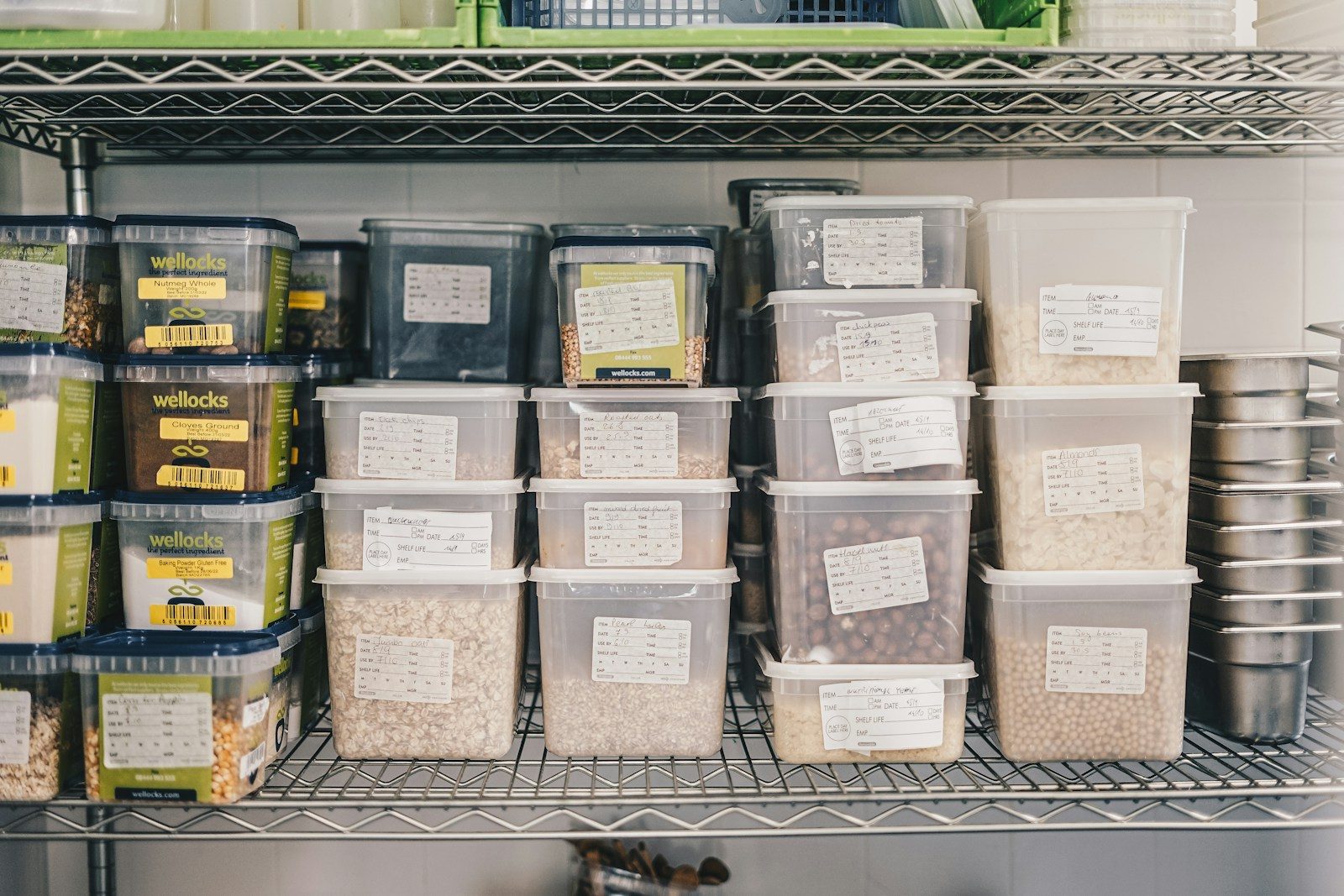
- ☐ Food is kept in sealed bags or containers where appropriate to protect it from contamination and pests.
- ☐ Food is not stored beside cleaning products, fuels, garden chemicals or other non-food substances.
- ☐ Food is not stored directly on the floor.
- ☐ The location is above likely flood water where this can be done safely.
- ☐ Shelves are stable and heavy packs are positioned so they can be reached without unsafe lifting.
- ☐ The reserve does not obstruct an exit, stairway, utility control or access to other emergency equipment.
- ☐ At least part of the supply can be found safely without mains lighting.
- ☐ More than one storage location is recorded if fire, flooding or a local leak could make the main location inaccessible.
| Storage area | Food or equipment kept there | Risk or action to address |
|---|---|---|
| Primary location | ________________________ | ________________________ |
| Second location | ________________________ | ________________________ |
| Baby or special-diet supply | ________________________ | ________________________ |
| Pet or assistance-animal supply | ________________________ | ________________________ |
| Manual opener and utensils | ________________________ | ________________________ |
Packaging, labels and date checks
- ☐ Follow the storage and preparation instructions on each label.
- ☐ Treat a use-by date as a food-safety limit. Do not eat food after its use-by date, even if it looks or smells normal.
- ☐ Treat a best-before date mainly as a quality date. Its meaning depends on correct storage and intact packaging.
- ☐ Set a household replacement date early enough that emergency stock remains dependable and can be used normally rather than wasted.
- ☐ Remove any leaking, swollen or seriously damaged pack from the usable stock and follow local waste guidance.
- ☐ Keep original labels or make sure any safe storage container retains the product name, allergen details, date and preparation instructions.
- ☐ Check instructions for refrigeration after opening and how quickly the food must then be used.
- ☐ Do not plan to keep leftovers in an opened tin. Transfer them to a clean container and refrigerate only when safe refrigeration is available.
- ☐ Record the earliest replacement dates at the front of the storage area or on this sheet.
Stock inventory and rotation sheet
Record packs, not just product names. One large pack may provide several portions but can also create a leftover problem during an outage. Put the items with the earliest appropriate rotation date at the front and use them first.
| Food item | Meal or use | Packs held | Portions held | Earliest date | Replace by |
|---|---|---|---|---|---|
| ________________ | ________________ | ______ | ______ | ____________ | ____________ |
| ________________ | ________________ | ______ | ______ | ____________ | ____________ |
| ________________ | ________________ | ______ | ______ | ____________ | ____________ |
| ________________ | ________________ | ______ | ______ | ____________ | ____________ |
| ________________ | ________________ | ______ | ______ | ____________ | ____________ |
| ________________ | ________________ | ______ | ______ | ____________ | ____________ |
| ________________ | ________________ | ______ | ______ | ____________ | ____________ |
| ________________ | ________________ | ______ | ______ | ____________ | ____________ |
Fridge and freezer planning for a power cut
Do not count chilled or frozen food as dependable core emergency stock. It may be useful early in an outage, but safe time depends on temperature, how full the appliance is, its model, the room temperature and how often the door is opened.
- ☐ Keep fridge and freezer doors closed as much as possible during a power cut.
- ☐ Keep a fridge thermometer in place. A fridge should normally be 5°C or below.
- ☐ Use the Food Standards Agency estimates as prompts, not guarantees: a closed fridge may remain cold for up to 4 hours, a full freezer for up to 48 hours and a half-full freezer for up to 24 hours.
- ☐ If the fridge reaches 8°C or above, eat food that normally requires refrigeration within 4 hours or discard it in line with official guidance.
- ☐ Use food in this order where it is safe: chilled food, defrosted frozen food that needs no cooking, room-temperature perishable food, then shelf-stable tinned, bottled and dried food.
- ☐ Take extra care for babies, young children, pregnant people, older people and anyone with an underlying health condition because food poisoning may cause more serious illness.
- ☐ Follow current official advice if it differs from this planning checklist.
Review and rotation schedule
- ☐ Every six months: count usable portions and compare them with the household target.
- ☐ Every six months: check dates, labels, seals, containers, damp, heat exposure and signs of pests.
- ☐ Every six months: test the manual opener and confirm that stored foods can still be opened and eaten by the intended users.
- ☐ Use items approaching the household replacement date in normal meals and replace them with equivalent food.
- ☐ After changing a product: check the new pack size, portion count, ingredients, allergens and preparation method.
- ☐ After a move, leak, flood warning, pest problem or storage-area temperature problem: inspect the entire reserve.
- ☐ After a change in household members, health, diet, infant feeding or pet needs: recalculate the target and replace unsuitable items.
- ☐ After using the reserve: record what worked, replace what was consumed and change foods that proved impractical.
Final ready check
- ☐ The recorded stock meets the household target without relying on chilled food.
- ☐ There is at least one complete no-cook meal combination for each planned meal period.
- ☐ All stored items are in date, correctly stored, clearly labelled and safe for the intended person or animal.
- ☐ The food can be reached, opened, prepared and eaten during a power or water outage.
- ☐ Water, hygiene supplies and safe utensils are available for the chosen foods.
- ☐ The next review date is written down: ________________________
Emergency food storage resources and official guidance
- GOV.UK Prepare household guidance covers emergency supplies, no-cook food, water, infant formula and pet needs.
- GOV.UK Prepare power-cut guidance explains how to prepare for outages and why food should not depend on cooking.
- Food Standards Agency power-cut advice provides fridge and freezer time estimates, temperature guidance and a food-use order for England, Wales and Northern Ireland.
- Food Standards Scotland power-cut advice provides the corresponding guidance for Scottish households.
- Food Standards Scotland food-storage guidance explains label checks, cupboard storage, sealed containers and separation from chemicals.
- Food Standards Scotland date-marking guidance explains the safety difference between use-by and best-before dates.
- NHS infant-formula guidance explains sterilising equipment, water temperature and safe preparation.
- NHS Eatwell Guide helps households consider balance and variety across a day or week.