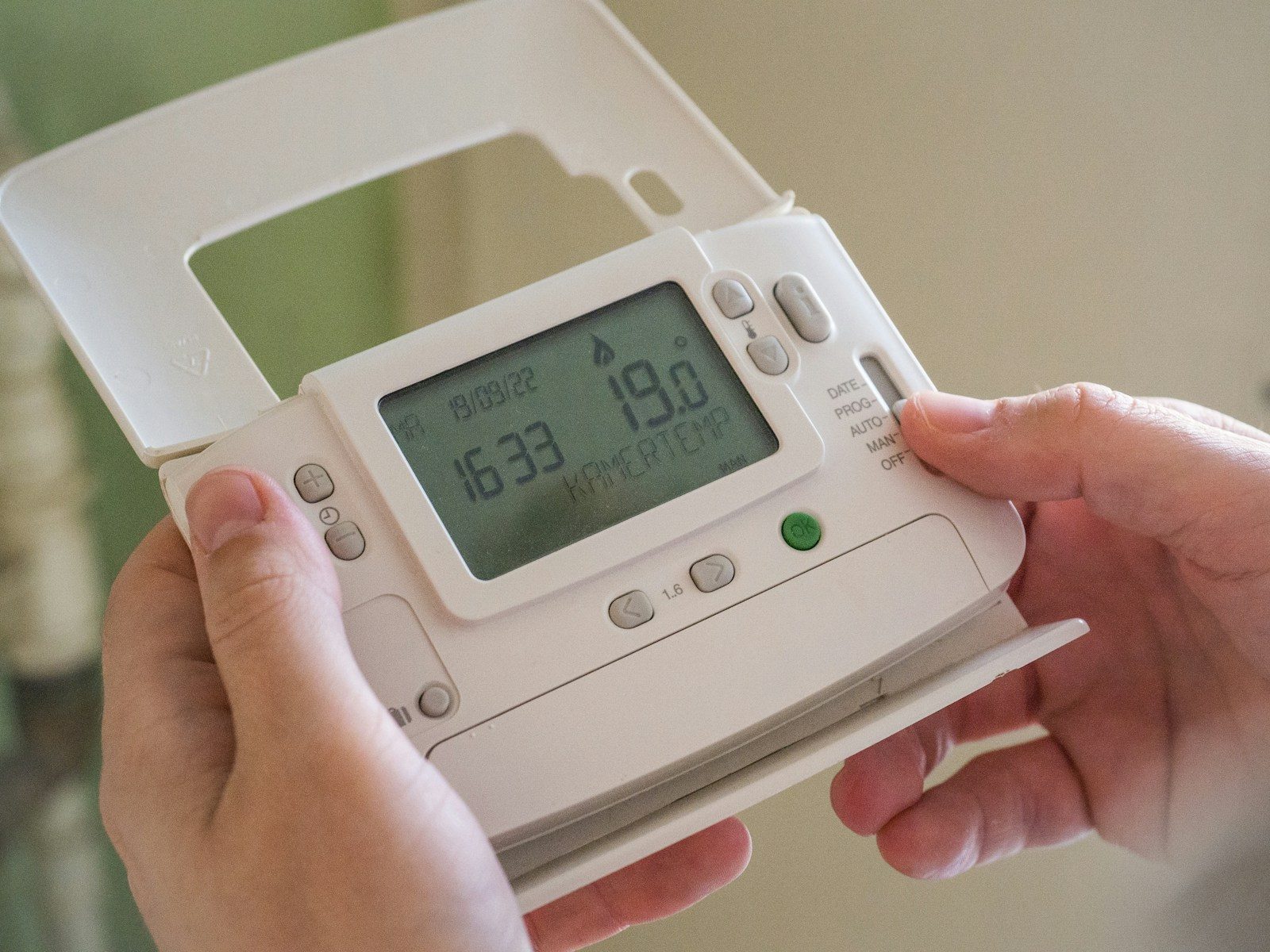
For checking one appliance, a plug-in LCD meter is usually the simplest and most dependable choice. A smart plug adds app history and scheduling, while a current-transformer clamp shows whole-home trends but normally needs more careful installation and is not a replacement for your supplier’s billing meter. Compare energy in kWh rather than judging an appliance from one momentary watt reading, and enter your actual tariff if the monitor estimates cost. Our guides to measuring electricity use at home and the appliances that use the most electricity explain the figures in more detail. For prices and ordering, click on the product image.
Best Electricity Usage Monitors – our recommendations
Brennenstuhl Primera-Line PM 231 E GB
Brennenstuhl’s PM 231 E is the strongest conventional choice for most households. It measures watts, voltage, current, frequency and power factor, then records total kWh, elapsed time and estimated cost. Two tariff settings are useful for day and night rates, while three LR44 batteries preserve the stored figures during a power cut. There is no app, account or wireless setup, which makes it easy to move between a fridge, television and office equipment. The display and small buttons are less convenient in a low socket, so a short, correctly rated extension lead may improve access.
Tapo P110 Smart Plug
The P110 is a sensible smart option if you already use the Tapo app or want an inexpensive way to keep a long-term eye on one appliance. It reports current and historical energy use, can estimate cost after you enter a tariff, and adds schedules, auto-off and remote control. Its compact 13A UK body normally leaves the neighbouring socket usable, and it works with Alexa and Google Assistant without a separate hub. Unlike a screen-based meter, its useful history depends on the app and network service. Treat calculated cost as a guide because standing charges and tariff changes are not automatically part of every estimate.
Tapo P110M Matter Smart Plug
Choose the P110M rather than the ordinary P110 when Matter compatibility matters. It retains energy tracking, schedules and auto-off functions in the Tapo app, while Matter allows basic control through compatible Apple, Google, Alexa and SmartThings systems. That makes it a better fit for a mixed-brand smart home. Energy data exposed by third-party Matter platforms can vary with the controller and its software, so the Tapo app remains the safest route to the complete monitoring view. It is rated for UK socket use, but a 13A label is not permission to ignore the connected appliance manufacturer’s advice or signs of heat.
Energenie ENER007 Power Meter
Energenie’s ENER007 is another straightforward meter for people who prefer local controls to a phone app. It can show energy, running cost, carbon estimate and operating time, and its LR44 batteries retain settings and records when the meter is unplugged. This is useful for multi-day tests of fridges, freezers and other cycling appliances where a single instantaneous reading is misleading. The casing is bulkier and the interface feels older than the backlit KETOTEK and LOWENERGIE designs. Its cost and carbon figures are only as useful as the values entered, but the underlying kWh total remains the important result.
LOWENERGIE Backlit Plug-in Energy Monitor
LOWENERGIE combines a readable backlit screen with the measurements most households actually need: watts, volts, amps, accumulated kWh and estimated cost. The maker specifies a 13A, 3,000W maximum and a 0.1W minimum displayed power, making it more informative for standby loads than some coarse displays. It is a good choice for sockets under desks or behind furniture where an unlit LCD is difficult to read. The body still has to sit between the wall and appliance, and its stated accuracy changes across the measurement range. Do not use it for a load above its rating or where either plug becomes hot.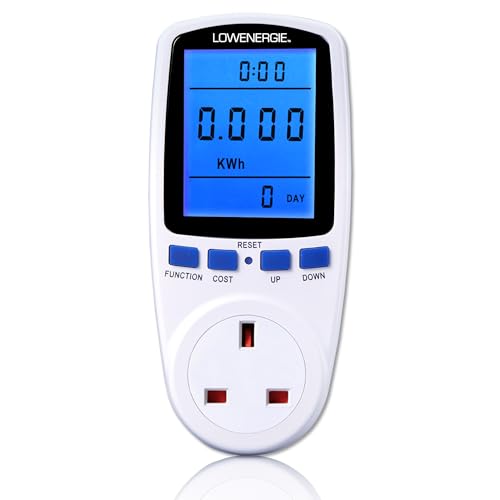
KETOTEK 11-Mode Power Meter Plug
This KETOTEK provides a wide set of readings without requiring Wi-Fi. Its 11 modes cover time, live power, cumulative energy, current, voltage, frequency, power factor, minimum and maximum power, cost and a carbon estimate. Power factor is particularly useful when comparing motors, compressors and electronic power supplies rather than simple resistive heaters. The interface cycles many figures through a relatively small screen, so it takes longer to learn than a model with dedicated buttons. This particular listing is the unlit version, which is best for an accessible socket in a bright room rather than a hidden outlet.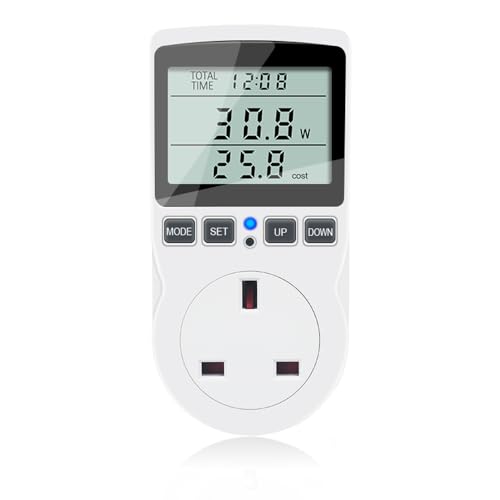
KETOTEK Backlit Five-Button Power Meter
The five-button KETOTEK is easier to navigate than meters that use one or two keys for every function. Its illuminated LCD shows live electrical data, accumulated kWh, running time and cost, while internal memory preserves records if the supply is interrupted. An overload setting can warn when a connected appliance exceeds the chosen threshold. This is a useful workshop or home-office meter when voltage, frequency and power factor matter as well as the bill estimate. As with any plug-in monitor, the alarm does not increase the safe rating of the socket, plug or appliance, and it should be removed immediately if there is discolouration, damage or unusual heat.
Meross MSS315 Matter Smart Plug Mini
The MSS315 is Meross’s Matter option for users who want one compact plug to work across several smart-home platforms. It combines live and historical energy monitoring with remote switching, timers and automations, and it can join Apple Home, Google Home, Alexa, SmartThings and other Matter systems. Initial setup and the fullest statistics are generally easiest in the Meross app, while the exact energy information shown elsewhere depends on that platform’s Matter support. This is a stronger choice for interoperability than for completely offline measurement. A compatible Matter controller is still required for many third-party ecosystems, despite the plug itself not needing a proprietary Meross hub.
Meross MSS305 Mini Smart Plug
The MSS305 is the simpler Meross alternative for homes that use Alexa, Google Home or SmartThings and do not need Matter. It records power consumption in the Meross app, supports schedules and remote switching, and has a 13A UK format. The conventional 2.4GHz Wi-Fi connection makes it easy to add without a separate gateway, while the large installed base gives it a more familiar app experience than many generic Smart Life plugs. It is less attractive for Apple Home users and people building a local Matter or Thread network. Cloud and router availability also affect remote features, although the physical button still provides basic control.
Eve Energy Matter UK Smart Plug
Eve Energy is the premium choice for a privacy-conscious Matter and Thread home. It measures power consumption and projected cost, runs automations, and communicates locally without an Eve cloud account. The Thread radio can also help extend a compatible Thread network. A suitable border router or home hub is required, and the available energy views depend on the chosen platform: Eve documents support through its own app and selected systems including Home Assistant and SmartThings. It costs more than mainstream Wi-Fi plugs, so its value rests on local operation, cross-platform Matter control and build quality rather than simply producing a cheaper kWh figure.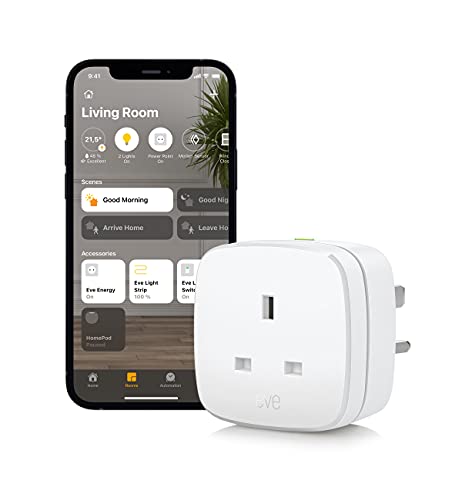
SONOFF S60TPG Wi-Fi Smart Plug
SONOFF’s S60TPG is a compact 2.4GHz Wi-Fi model for the eWeLink ecosystem. It tracks daily, monthly and annual consumption, supports remote switching and schedules, and allows maximum current, voltage and power thresholds to be configured. Alexa, Google Home and IFTTT support make it easy to include in basic routines without a separate hub. The eWeLink account and cloud service are part of the experience, so it is not the best fit for someone who wants a fully local monitor. Threshold protection is useful but should not be treated as a substitute for the plug fuse, circuit protection or safe loading.
SONOFF S60ZBTPG Zigbee Smart Plug
The S60ZBTPG exchanges Wi-Fi for Zigbee, which is valuable in homes with an eWeLink-compatible gateway or another supported Zigbee system. It reports energy use, offers timer schedules and overload protection, and acts as a Zigbee repeater for nearby devices. A mesh network can be more dependable than filling the router with many individual Wi-Fi plugs. The gateway is not optional, and energy entities are not guaranteed to appear identically through every third-party Zigbee coordinator. Buy it for a planned Zigbee setup, not as a standalone meter. Users wanting the simplest phone setup should choose the Wi-Fi S60TPG instead.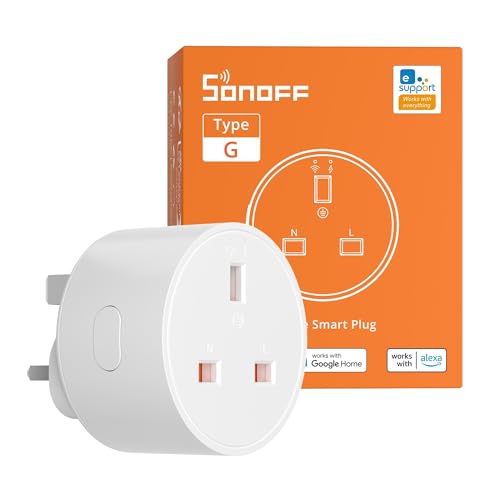
SONOFF S60TPG-M Matter Smart Plug
The S60TPG-M adds Matter to SONOFF’s UK 13A plug format. It combines real-time energy monitoring, timers and app control with broad support for compatible smart-home platforms, without requiring a SONOFF hub. This makes it a useful middle ground for someone who likes eWeLink but wants less dependence on a single control ecosystem. As with other Matter energy products, platform support is evolving and a controller may expose switching before it exposes every measurement. Use the manufacturer’s app when detailed history is important, and confirm that the appliance is suitable for automated switching before creating unattended schedules.
Aqara Wall Outlet H2 UK
This is a fixed double socket rather than a plug-in adaptor. It provides independent outlet control, USB-C charging and energy reports, with a choice of Matter over Thread or Aqara Zigbee operation. Detailed per-outlet monitoring requires Zigbee mode; Thread mode reports the combined load. The integrated appearance and physical buttons make it attractive for a permanent smart-home installation, but it is not a casual DIY monitor. Replacement of a wall socket involves fixed mains wiring and should be carried out by a competent electrician in accordance with the installation instructions and UK wiring requirements. An appropriate Matter controller or Aqara hub is also required.
Efergy E-Max Single-Phase Kit
E-Max is the better Efergy choice when a large, clear display matters. Its 7.9-inch colour screen presents current use, budgets and history more clearly than the Elite Classic, has a battery for room-to-room use and can export data through USB. This Amazon kit contains one 16mm current-transformer sensor for a suitable single-phase installation. It does not provide the phone-first experience of a cloud monitor, but that is an advantage for local, glanceable feedback. Installation must not expose the user to live conductors; if a safe clamp point is not already accessible, use a competent electrician rather than opening a consumer unit.
Refoss EM06P Six-Channel Smart Energy Monitor
The EM06P is the advanced choice for monitoring several circuits, phases or renewable-energy flows. Six channels each accept a current-transformer input up to 120A, with voltage, current, active power and power-factor data, tariff schedules, alerts and long-term charts. It also offers a local web interface plus MQTT, HTTP and WebSocket integration for Home Assistant users. This is an EU DIN-rail product that requires a neutral connection and fixed wiring, not a clip-on consumer accessory. Have an electrician confirm enclosure space, supply topology and regulatory suitability before purchase. Its high level of detail is unnecessary if the aim is simply to test a kettle or fridge.
Emporia Vue 3 Three-Phase Smart Energy Monitor
Emporia’s Vue 3 is the most capable system here for detailed circuit-level tracking. The three-phase kit can also support compatible single-phase arrangements and includes branch sensors for separating major circuits, with app history, solar and net-metering support and automation links. Emporia specifies sensor accuracy around 2 percent under suitable conditions, but correct voltage references and clamp orientation are essential. The hardware sits in or beside distribution equipment and uses 2.4GHz Wi-Fi, so both electrical space and a reliable signal matter. Professional installation is the sensible UK approach, and the result still supplements rather than replaces the supplier’s certified meter.
Electricity Usage Monitor Resources
- How to measure electricity use at home – UK Prepared’s explanation of watts, kWh, appliance testing and whole-home readings.
- What appliances use the most electricity? – A practical guide to the loads most worth measuring first.
- How to reduce electricity use at home – Ways to turn monitoring results into realistic savings.
- Ofgem smart meter guidance – Explains supplier smart meters, in-home displays and access to usage data.
- Energy Saving Trust smart meter guide – Advice on smart meters, in-home displays and what to do if a display stops working.
- Electrical Safety First socket-overloading advice – Guidance on plug, extension lead and total-load safety.
- UK product safety alerts, reports and recalls – Search the official database before buying or continuing to use a mains-powered monitor.
- OPSS electricity-saving box recall – An example of a plug-in device recalled for serious electric-shock and fire risks.
Click the button below to purchase all of the products in this Best Electricity Usage Monitors guide from Amazon.
Buy from Amazon.co.ukDisclosure: as an Amazon Associate, UK Prepared earns from qualifying purchases.